
B2B Lead Generation in Singapore
90% of B2B firms fail at this – do you?
2 minutes to find out
- Targeting the right accounts
- Routing leads to sales fast
- Attribution that makes sense
No email required to start
Generating B2B leads in Singapore is not simply about finding more companies or collecting more contact details. The real objective is to identify the right businesses, reach the right decision-makers, create genuine interest, qualify potential buyers and turn that interest into meaningful sales opportunities.
iSmart Communications provides AI-driven B2B lead generation services in Singapore and across Asia, combining artificial intelligence, data, digital marketing and human expertise to help businesses build a more consistent sales pipeline.
Our B2B lead generation approach can combine SEO, AI content generation, Google Ads, LinkedIn marketing, account-based marketing (ABM), prospect research, B2B database development, lead qualification, marketing automation and appointment setting.
We begin by understanding your Ideal Customer Profile (ICP), target industries, buyer personas, products or services and sales objectives. We then develop a lead-generation strategy designed to reach prospects through the channels most relevant to their buying behaviour.
The goal is not simply to generate a high volume of leads. It is to generate relevant, qualified B2B leads that have a realistic potential to become sales opportunities and customers.
Want a lead generation programme built around your ICP?
Tell us your target market and we will map the channels, messaging and qualification criteria that fit it.
What Is B2B Lead Generation?
B2B lead generation is the process of identifying, attracting, engaging and qualifying potential business customers that may have a need for a company’s products or services.

Unlike B2C lead generation, which generally targets individual consumers, B2B lead generation targets businesses and the people involved in making business purchasing decisions. These may include CEOs, Managing Directors, CIOs, CTOs, IT Directors, Marketing Directors, Procurement Managers and other decision-makers or influencers.
A B2B lead can originate from many different sources, including:
- Search engines
- Google Ads
- SEO
- Content marketing
- Email marketing
- Business databases
- Account-based marketing
- Events and webinars
- Referrals
- Digital advertising
- Outbound prospecting
However, a contact is not automatically a qualified lead simply because their information has been collected.
What Is a Qualified B2B Lead?
A qualified B2B lead is a prospect that meets agreed criteria indicating that the company and contact are potentially relevant to the products or services being offered.
Qualification can consider:
- Industry
- Company size
- Geographic location
- Job role
- Decision-making authority
- Business requirements
- Existing solutions
- Potential budget
- Buying intent
- Purchase timeframe
For example, a Singapore cybersecurity company targeting financial institutions may define a qualified lead as a company operating in financial services, with an appropriate level of IT or security infrastructure, where the relevant CIO, CISO or IT decision-maker has a potential requirement for its solution.
B2B Lead Generation Is More Than Building a Database
A database gives a company information about potential prospects. Lead generation goes further by creating awareness, engagement and potential demand among those prospects.
This distinction is particularly important for B2B companies. Having thousands of contacts does not necessarily produce sales opportunities.
Effective B2B lead generation connects targeting, messaging, engagement, qualification and follow-up into a structured process.
How Does B2B Lead Generation Work?
B2B lead generation works by identifying the right target companies and decision-makers, reaching them through appropriate marketing channels, engaging them with relevant information, qualifying their interest and progressing suitable prospects towards a sales conversation.
The ten stages
A successful B2B lead generation programme normally consists of several connected stages.
1. Define the Ideal Customer Profile
The first step is determining exactly which companies are most likely to become valuable customers.
An Ideal Customer Profile can include:
- Industry
- Company size
- Revenue
- Location
- Business model
- Technology environment
- Growth stage
- Number of employees
- Existing solutions
- Business challenges
The more clearly the ICP is defined, the easier it becomes to identify relevant prospects and create appropriate marketing messages.
2. Identify Buyer Personas
The next step is identifying the people involved in the purchasing process.
Depending on the product or service, this might include:
- CEO
- Managing Director
- CIO
- CTO
- CISO
- IT Director
- Marketing Director
- Marketing Manager
- Procurement Manager
- Operations Director
- Finance Director
Different stakeholders may have different priorities, so the messaging should reflect their specific responsibilities and concerns.
3. Research Target Accounts
Once the ICP and buyer personas have been established, relevant companies and prospects can be identified.
For larger B2B campaigns, this can form the foundation of an Account-Based Marketing (ABM) strategy, where specific high-value organisations are prioritised.
4. Select the Right Lead Generation Channels
There is no single B2B lead generation channel that works for every company.
Depending on the target audience and buying journey, appropriate channels may include:
- SEO
- Google Search Ads
- LinkedIn Ads
- Content marketing
- Email marketing
- AI-assisted prospecting
- ABM
- Digital advertising
- Webinars
- Events
- Appointment setting
- Marketing automation
The objective is to match the channel to the way your target buyers research and evaluate suppliers.
5. Create Relevant Marketing Content
Once the audience is defined, content and messaging should address the problems, questions and objectives of those buyers.
This may include:
- Service pages
- Blog articles
- Case studies
- White papers
- Buyer guides
- Videos
- LinkedIn content
- Landing pages
- Email campaigns
- Industry-specific content
For modern B2B marketing, this content also needs to be structured so that search engines and AI-powered answer engines can understand the subject and context.
6. Attract and Engage Prospects
Potential buyers are then reached through the selected channels.
For example, SEO can capture prospects actively researching a problem, while LinkedIn can help identify and engage specific professional audiences.
Google Search Ads can capture high-intent searches, while content marketing can help prospects understand a complex product or service.
7. Capture and Qualify Leads
Interested prospects can be captured through landing pages, forms, calls, emails, CRM systems and other conversion mechanisms.
Leads can then be evaluated against agreed qualification criteria.
8. Nurture Prospects
Not every prospect is ready to buy immediately.
Lead nurturing keeps relevant prospects engaged through:
- Educational content
- Email campaigns
- Remarketing
- Case studies
- Product information
- Industry insights
- Follow-up communications
The objective is to remain relevant until the prospect is ready to have a sales conversation.
9. Generate Sales Appointments
For businesses that use an appointment-setting model, qualified prospects can be progressed towards meetings with the appropriate sales representative.
This creates a bridge between marketing-generated interest and the sales process.
10. Measure and Optimise
The final stage is continuous measurement and optimisation.
Important metrics can include:
- Qualified leads
- Cost per lead
- Cost per qualified lead
- Lead-to-opportunity conversion
- Appointments
- Opportunities created
- Pipeline value
- Customer acquisition cost
- Revenue generated
The focus should be on business outcomes rather than lead volume alone.
Not sure which channels fit your buyers?
We will recommend a channel mix based on your industry, deal size and sales cycle. No obligation.
B2B Lead Generation Services We Provide
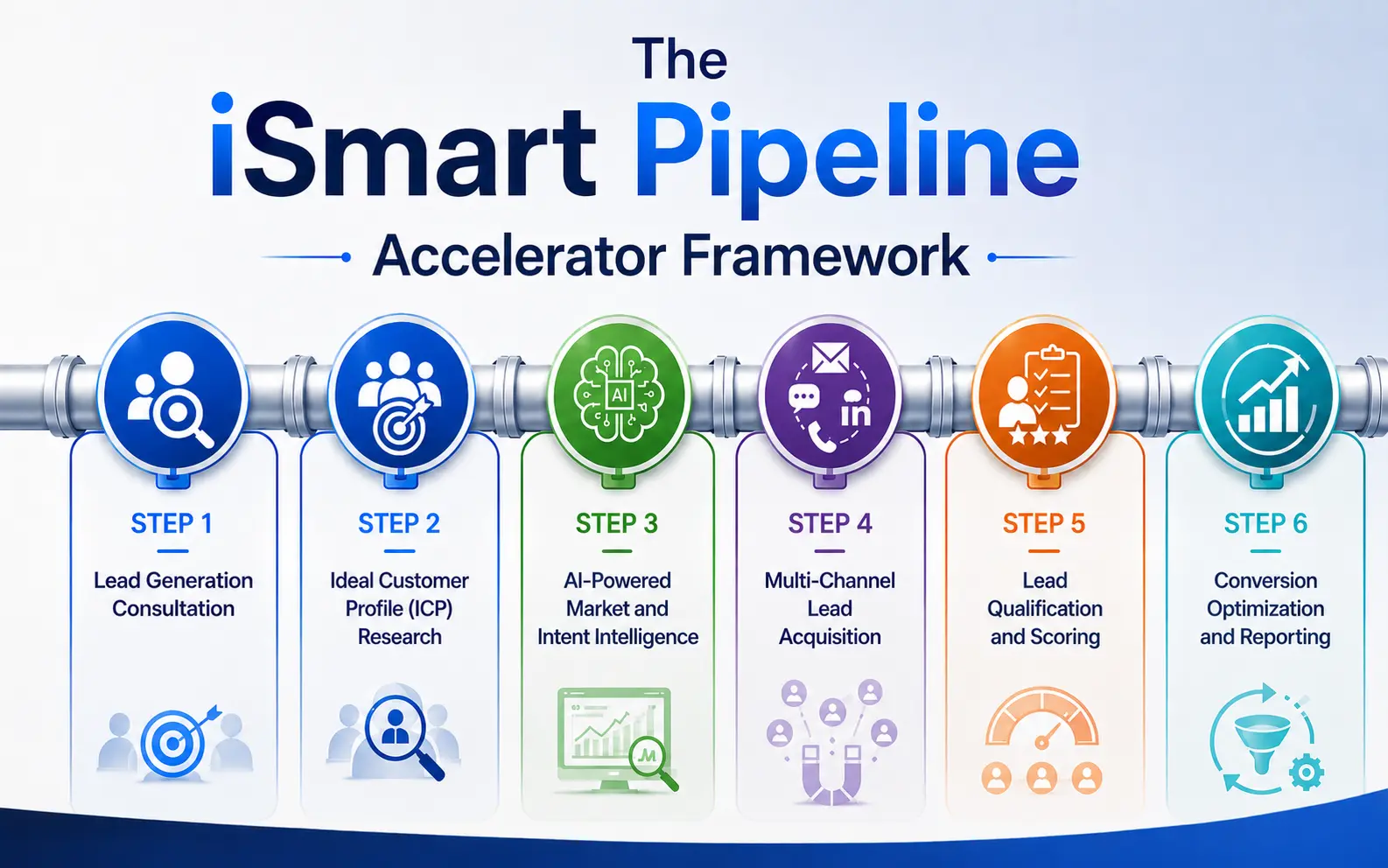
iSmart Communications provides an integrated range of B2B lead generation services in Singapore and Asia. Rather than relying on one marketing channel, we can combine different strategies according to your target market, customer profile and sales objectives.
AI-Powered B2B Lead Generation
AI can be incorporated into different stages of the lead generation process, including prospect research, data analysis, content development, personalisation, lead segmentation and campaign optimisation.
Our approach combines AI capabilities with human marketing strategy and quality control.
B2B SEO and Content Marketing
SEO and content marketing help attract potential buyers who are researching products, services, suppliers and business solutions online.
We can develop content around:
- Commercial keywords
- Industry-specific problems
- Buyer questions
- Product comparisons
- Service requirements
- Educational topics
- Long-tail search queries
- AI search and answer-engine queries
The objective is to attract relevant business prospects rather than simply generate website traffic.
LinkedIn B2B Lead Generation
LinkedIn provides access to professional audiences and can be particularly useful for reaching specific industries, companies, job functions and seniority levels.
B2B LinkedIn campaigns can include:
- Target account identification
- Prospect research
- Audience segmentation
- Content marketing
- LinkedIn advertising
- Prospect engagement
- Lead generation campaigns
Google Ads for B2B Lead Generation
Google Search Ads can capture potential customers who are actively searching for products or services.
Campaigns can be structured around commercial and high-intent keywords and directed towards dedicated landing pages designed to generate enquiries.
Account-Based Marketing
Account-Based Marketing (ABM) focuses marketing and sales resources on a defined group of high-value target accounts.
Rather than communicating with a broad audience using the same message, ABM allows campaigns to be tailored according to:
- Target account
- Industry
- Business problem
- Buyer persona
- Decision-maker
- Buying stage
ABM can be particularly valuable for companies selling high-value products or services to a relatively small number of potential customers.
B2B Database Development and Prospect Research
A successful lead-generation campaign requires relevant prospect data.
We can help businesses identify target companies and relevant decision-makers based on agreed criteria.
The objective is to create a useful and relevant prospect universe, rather than simply producing a large database.
Lead Qualification
Lead qualification helps determine which prospects are sufficiently relevant to progress through the sales process.
Criteria can include:
- Company fit
- Job function
- Seniority
- Business need
- Buying intent
- Timing
- Potential commercial value
B2B Appointment Setting
For companies that require direct sales conversations, qualified prospects can be progressed towards sales appointments.
Appointment setting can provide sales teams with a more structured pipeline of potential business conversations.
Marketing Automation and Lead Nurturing
Marketing automation can help businesses manage:
- Lead capture
- Segmentation
- Lead scoring
- Email sequences
- Follow-up
- Lead nurturing
- CRM workflows
- Reporting
Automation can reduce repetitive marketing tasks while helping businesses maintain consistent communication with prospects.
How AI Improves B2B Lead Generation
AI can improve B2B lead generation by helping marketers research prospects, analyse data, personalise communication, produce content, prioritise leads and optimise campaigns more efficiently.

AI is particularly useful when large amounts of information need to be processed quickly.
AI for Prospect Research
AI can assist marketers in analysing information about companies, industries, markets and potential prospects.
This can help marketing teams identify patterns and prioritise accounts that appear to fit their ICP.
AI for Lead Segmentation
AI can help organise prospects into meaningful groups based on characteristics such as:
- Industry
- Company size
- Location
- Job role
- Business requirements
- Engagement
- Buying signals
Better segmentation allows businesses to create more relevant marketing campaigns.
AI for Personalised Marketing
B2B buyers are more likely to respond to information that reflects their specific business situation.
AI can help create different versions of marketing messages for different industries, personas or account groups.
For example, a cybersecurity campaign targeting a bank’s CIO may require very different messaging from a campaign targeting the IT Manager of a manufacturing company.
AI for Content Generation
AI can accelerate the production of:
- Blog articles
- Landing pages
- Email campaigns
- LinkedIn posts
- Advertisements
- Buyer guides
- FAQs
- Sales enablement content
However, AI-generated content should be reviewed and improved by people with appropriate subject-matter knowledge.
The objective should be better and more useful content, not simply more content.
AI for Lead Scoring
AI-assisted lead scoring can help marketers prioritise prospects according to defined characteristics and engagement signals.
This can help sales teams focus their attention on prospects that appear more relevant.
AI for Campaign Optimisation
AI can assist with analysing campaign performance and identifying opportunities to improve:
- Targeting
- Messaging
- Content
- Advertising
- Conversion rates
- Lead quality
- Budget allocation
AI + Human Expertise
AI should not be viewed as a complete replacement for experienced marketers.
The strongest B2B lead generation programmes combine:
AI + Data + Marketing Strategy + Human Expertise + Sales Knowledge
AI can accelerate research and execution, while human expertise provides strategic judgement, creativity, context and quality control.
Who Is B2B Lead Generation For?
B2B lead generation is most suitable for companies that sell products or services to other businesses and have a clearly identifiable target market and decision-making audience.

It can be particularly valuable when products or services have a meaningful commercial value and the company needs a consistent flow of new business opportunities.
Technology and SaaS Companies
Software and SaaS companies often need to reach specific organisations and decision-makers rather than a general consumer audience.
Potential targets can include:
- CIOs
- CTOs
- IT Directors
- Digital Transformation Directors
- Procurement Managers
- Business Owners
Cybersecurity Companies
Cybersecurity companies can use targeted B2B lead generation to reach organisations with specific security requirements.
Potential decision-makers include:
- CISOs
- CIOs
- IT Directors
- Security Managers
- Risk Managers
Telecommunications Companies
Telecommunications and communication technology providers can target businesses according to their size, infrastructure, technology requirements and communication needs.
IT Services and System Integrators
IT service providers can use lead generation to identify organisations with potential requirements for:
- Cloud services
- IT infrastructure
- Managed services
- Systems integration
- Software implementation
- Digital transformation
- Cybersecurity
Professional Services and Consultants
Consultancies and professional service providers can use B2B lead generation to reach companies that may require specialist expertise.
Manufacturing and Industrial Companies
Manufacturing businesses and industrial service providers can use account-based targeting to reach procurement, engineering, operations and senior management teams.
B2B Marketing and Advertising Services
Marketing agencies can use B2B lead generation to reach companies that need specialist marketing, advertising, SEO, content, AI or digital services.
When B2B Lead Generation May Not Be Appropriate
B2B lead generation may be less suitable when:
- The target market is extremely small
- There is no clearly defined buyer
- The product has very low customer value
- The company has no sales process
- Leads cannot be followed up effectively
- The business has not established a viable product-market fit
Before investing in lead generation, it is important to establish whether there is a sufficiently attractive market and a clear value proposition.
Expanding from Singapore into Asia?
We adapt target accounts, personas and messaging market by market rather than translating one Singapore campaign into another language.
B2B Lead Generation for Singapore Companies
B2B lead generation for Singapore companies requires an understanding of the local business environment, target industries, decision-makers and buying processes.

Singapore is both a significant business market in its own right and a regional base for companies operating across Asia.
This creates opportunities for businesses that want to target:
- Singapore SMEs
- Large Singapore enterprises
- Multinational corporations
- Regional headquarters
- Technology companies
- Financial services organisations
- Manufacturing companies
- Professional services firms
- Government-related organisations
- Companies expanding into Southeast Asia
Targeting Singapore SMEs
Singapore SMEs can have very different requirements from multinational corporations.
For SMEs, factors such as:
- Budget
- Ease of implementation
- Return on investment
- Business impact
- Speed of deployment
- Supplier responsiveness
may play an important role in the buying process.
B2B marketing campaigns should therefore communicate practical business value rather than simply technical features.
Targeting Singapore Enterprises
Enterprise sales can involve considerably more stakeholders.
A technology purchase, for example, may involve:
- Business management
- IT
- Procurement
- Finance
- Security
- Legal
- Operations
Lead-generation campaigns targeting enterprise organisations therefore need to consider the wider buying committee rather than focusing on a single contact.
Singapore as a Gateway to Asia
For companies using Singapore as a regional base, B2B lead generation can also support expansion into other Asian markets.
However, Asia should not be treated as a single homogeneous market.
Different countries can have significant differences in:
- Business culture
- Language
- Buyer behaviour
- Digital channels
- Regulatory requirements
- Procurement practices
- Competitive environment
- Price sensitivity
A successful regional B2B lead-generation strategy therefore needs to combine a common strategic framework with appropriate local adaptation.
Combining Local Expertise with AI
AI can help process large amounts of market and prospect information, but local market knowledge remains important.
For Singapore B2B campaigns, this means combining:
AI + Data + Local Market Knowledge + B2B Marketing Expertise
The result is a more targeted approach to identifying companies and decision-makers that are relevant to your products or services.
From Singapore to Asia
For businesses seeking growth beyond Singapore, a lead-generation programme can be progressively adapted to markets such as:
- Malaysia
- Indonesia
- Thailand
- Vietnam
- Other Asia-Pacific markets
The target account criteria, buyer personas, messaging and channels should be reviewed for each market rather than simply translating a Singapore campaign into another language.
What Makes a Good B2B Lead?
A good B2B lead is a prospect that closely matches your Ideal Customer Profile and has a credible business need, relevant decision-making role and potential interest in your product or service.
Six qualification criteria
Lead quality is more important than lead volume.
A company that generates 1,000 irrelevant contacts may achieve a lower commercial outcome than a company that generates 50 highly relevant prospects.
1. Company Fit
The prospect’s company should match your ICP.
Relevant criteria can include:
- Industry
- Company size
- Revenue
- Geography
- Business model
- Technology environment
2. Right Decision-Maker
The contact should have an appropriate role in the buying process.
Depending on the product, this may be:
- CEO
- CIO
- CTO
- CMO
- IT Director
- Marketing Director
- Procurement Manager
- Operations Director
The correct job title varies according to the product and purchasing process.
3. Relevant Business Need
A strong lead should have a problem, requirement or objective that your product or service can address.
For example, a company looking for a cybersecurity solution is potentially more relevant to a cybersecurity provider than a company with no identified security requirement.
4. Buying Intent
Buying intent indicates whether the prospect may be actively researching or considering a solution.
Intent can be reflected through activities such as:
- Searching for solutions
- Visiting relevant pages
- Downloading information
- Requesting information
- Engaging with content
- Responding to outreach
- Requesting a demonstration
Intent signals should be interpreted carefully rather than treated as guaranteed evidence of purchase.
5. Timing
A prospect may fit your ICP but not be ready to purchase.
For example:
Company A: Fits the ICP but has no current requirement.
Company B: Fits the ICP and is currently evaluating suppliers.
Company B may be a higher-priority sales lead because the timing is more relevant.
6. Potential Commercial Value
Lead qualification can also consider the potential value of the opportunity.
For high-value B2B products, it may make sense to focus more resources on accounts with a meaningful potential customer value.
B2B Lead vs MQL vs SQL vs Opportunity
Understanding these terms helps marketing and sales teams establish consistent lead qualification criteria.
From lead to opportunity
Lead
A person or organisation that has been identified as a potential prospect.
Marketing Qualified Lead
An MQL is a lead that meets defined marketing criteria suggesting that it is sufficiently relevant or engaged to receive additional marketing or sales attention.
Sales Qualified Lead
An SQL is a prospect that meets agreed sales criteria and is considered appropriate for direct sales engagement.
Opportunity
An opportunity represents a more advanced commercial situation where there is a realistic possibility of a sale.
These definitions should be agreed between marketing and sales because different companies can use different qualification criteria.
B2B Lead Generation vs Buying a B2B Database
Buying a B2B database and generating B2B leads are not the same thing. A database provides information about potential prospects, while lead generation aims to create engagement, interest and qualified sales opportunities from relevant prospects.
Data alone is not a pipeline
A database may contain:
- Company names
- Contact names
- Job titles
- Email addresses
- Telephone numbers
- Industry information
- Company size
- Geographic information
This information can be useful as an input into a lead-generation campaign.
However, simply possessing contact information does not mean that those contacts:
- Need your product
- Know your company
- Are currently looking for a solution
- Have buying authority
- Have budget
- Are ready to speak with sales
Database Building
Database development focuses primarily on identifying potential accounts and contacts.
The key questions are:
- Who should we target?
- Who are the relevant decision-makers?
- How can we obtain accurate and relevant prospect information?
B2B Lead Generation
Lead generation asks additional questions:
- How do we reach these prospects?
- How do we create interest?
- How do we demonstrate value?
- How do we identify genuine interest?
- How do we qualify the prospect?
- How do we move the prospect towards a sales conversation?
Comparison
| Activity | Main Objective |
|---|---|
| B2B database building | Identify potential prospects |
| Prospect research | Determine which accounts and contacts are relevant |
| Lead generation | Create interest and engagement |
| Lead qualification | Determine whether prospects meet agreed criteria |
| Lead nurturing | Develop relationships with prospects not yet ready to buy |
| Appointment setting | Create qualified sales conversations |
| Demand generation | Build awareness and interest across the buying journey |
| ABM | Focus resources on selected high-value accounts |
Why Database Size Is Not the Same as Lead Quality
A database containing 50,000 contacts may appear impressive, but its commercial value depends on factors such as:
- Accuracy
- Relevance
- Recency
- ICP alignment
- Decision-maker relevance
- Business need
- Buying intent
- Engagement
A smaller database of highly relevant target accounts can potentially be more useful than a large database containing poorly matched prospects.
The Best Approach: Data + Engagement + Qualification
For many B2B companies, database development should be viewed as one component of a wider lead-generation strategy.
A more complete process is:
Identify → Research → Target → Engage → Capture → Qualify → Nurture → Convert → Measure
This transforms raw prospect data into a structured process for developing potential sales opportunities.
For iSmart Communications, the objective is therefore not simply to provide a list of contacts. The broader objective is to use AI, data, digital marketing and human expertise to help B2B companies identify and engage the prospects that are most relevant to their business.
Ready to build a qualified B2B pipeline?
Get a free audit of your current lead generation programme, or start with the two-minute fit quiz to see where the gaps are.
Frequently Asked Questions About B2B Lead Generation in Singapore
1. What is B2B lead generation in Singapore?
B2B lead generation in Singapore is the process of identifying, attracting, engaging and qualifying potential business customers in the Singapore market. It can use channels such as SEO, Google Ads, LinkedIn, content marketing, ABM, email marketing, automation and appointment setting.
2. Why is B2B lead generation important for Singapore companies?
B2B lead generation helps companies create a systematic way of reaching potential business customers rather than relying entirely on referrals, networking or ad-hoc prospecting. A well-designed programme can help identify relevant prospects and create opportunities for the sales team.
3. How does B2B lead generation differ from B2C lead generation?
B2B lead generation generally targets organisations and professional decision-makers, while B2C lead generation targets individual consumers. B2B purchases can involve multiple stakeholders, longer decision cycles and greater emphasis on business requirements, credibility and return on investment.
4. What are the best B2B lead generation channels in Singapore?
The appropriate channels depend on the target audience and product. Common options include SEO, Google Search Ads, LinkedIn, content marketing, email, ABM, marketing automation, events and appointment setting. A multi-channel strategy is often more appropriate than relying on one channel.
5. How can AI improve B2B lead generation?
AI can assist with prospect research, segmentation, content development, personalisation, lead scoring, campaign analysis and optimisation. The strongest approach combines AI capabilities with human strategy, marketing expertise and quality control.
6. What is an Ideal Customer Profile?
An Ideal Customer Profile describes the characteristics of organisations that are most likely to become valuable customers. It can include industry, company size, geography, business model, technology environment, revenue and other relevant characteristics.
7. What is the difference between an ICP and a buyer persona?
An ICP describes the organisation you want to target. A buyer persona describes the individual decision-maker or stakeholder within that organisation. B2B campaigns often need both.
8. What makes a B2B lead qualified?
A qualified lead generally matches agreed criteria relating to company fit, buyer role, business need, potential value, timing and buying intent. Qualification criteria should be customised to the business rather than using one universal definition.
9. Can iSmart generate B2B leads through LinkedIn?
Yes. LinkedIn can form part of an iSmart B2B lead-generation programme. Campaigns can be designed around specific companies, industries, job functions, seniority levels and professional audiences.
10. Can iSmart generate leads through Google?
Yes. Google Search and other Google advertising channels can be incorporated into B2B lead-generation programmes where search demand exists. SEO can also be used to capture organic search demand over time.
11. Does iSmart provide appointment setting?
Yes. Appointment setting and lead qualification are among the B2B lead-generation capabilities offered by iSmart Communications.
12. Does iSmart provide account-based marketing?
Yes. iSmart offers account-based marketing as part of its B2B lead-generation capabilities. ABM is particularly relevant when a company has a defined list of high-value target accounts.
13. Is outsourcing B2B lead generation worth it?
Outsourcing can make sense when a company needs specialist expertise, additional marketing capacity, access to specific technologies or a more structured approach to prospect generation. The decision should be based on the expected commercial value and the company’s internal capabilities.
14. Should we build an internal lead-generation team or use an agency?
An internal team provides direct control but requires recruitment, management, technology and ongoing training. An agency can provide external expertise and execution capacity. Some companies use a hybrid model where internal sales teams work with an external lead-generation partner.
15. How much does B2B lead generation cost in Singapore?
There is no universal price because campaign scope varies considerably. iSmart currently publishes packages of approximately S$3,000–S$9,000 per month depending on requirements. The appropriate investment depends on target market, channels, content, advertising, automation, qualification and appointment-setting requirements.
16. How long does B2B lead generation take to produce results?
The timeframe depends on the industry, offer, audience, channels and sales cycle. Campaigns normally require an initial period for research, setup and testing followed by optimisation. B2B programmes should generally be assessed over an appropriate period rather than based on the first few days of activity.
17. Can B2B lead generation generate sales appointments?
Yes. Lead-generation programmes can incorporate lead qualification and appointment setting to move suitable prospects toward sales conversations. The quality of the underlying targeting and qualification process is important because generating meetings alone does not guarantee sales.
18. How do I measure B2B lead-generation performance?
Useful metrics can include qualified leads, cost per qualified lead, conversion rates, sales appointments, opportunities created, pipeline contribution and revenue. The right metrics should be connected to the company’s sales process.
19. What industries benefit most from B2B lead generation?
Industries with identifiable business buyers and sufficiently valuable products or services can benefit. Examples include SaaS, IT services, cybersecurity, telecommunications, professional services, manufacturing, consulting and other B2B sectors.
20. Can iSmart help companies generate B2B leads outside Singapore?
Yes. iSmart is based in Singapore and provides lead-generation programmes across Singapore and wider Asian markets. Campaigns can be adapted according to market, language, culture, buyer behaviour and local requirements.
21. What is the difference between lead generation and demand generation?
Lead generation focuses on identifying and capturing potential prospects, while demand generation takes a broader view of creating awareness, interest and demand for a product or service throughout the buying journey. The two activities often work together.
22. What is account-based marketing?
Account-based marketing is a B2B strategy that focuses marketing and sales resources on selected target companies. Rather than marketing broadly, ABM creates more targeted engagement around high-value accounts and their relevant stakeholders.
23. Can SEO generate B2B leads?
Yes. SEO can attract prospects who are actively researching problems, products and services through search engines. Effective B2B SEO focuses on commercially relevant search topics rather than traffic volume alone.
24. Can AI-generated content help B2B lead generation?
AI can help marketers produce and adapt content more efficiently, but content should still be reviewed for accuracy, originality, expertise, relevance and brand consistency. The goal should be useful content that helps buyers make decisions, not simply large volumes of automatically generated text.
25. How do I choose a B2B lead generation agency in Singapore?
Look for an agency that understands your target market, can explain its lead qualification process, has appropriate channel expertise, measures meaningful business outcomes and can demonstrate how marketing activity connects to sales opportunities.
26. What should a B2B lead-generation agency provide?
Depending on the programme, services may include strategy, ICP development, prospect research, database development, content, SEO, paid advertising, LinkedIn campaigns, ABM, marketing automation, lead qualification, appointment setting, CRM integration and reporting.
27. How can B2B companies improve lead quality?
Start with a clearly defined ICP, target the right decision-makers, create relevant messaging, use appropriate qualification criteria and measure downstream outcomes rather than just lead volume.
28. Is B2B lead generation suitable for SMEs in Singapore?
It can be, particularly when an SME has a clearly defined B2B target market and sufficient customer value to justify structured acquisition. The strategy and channel mix should be scaled to the company’s market, budget and sales capacity.
29. How can B2B lead generation support expansion into Asia?
A structured programme can help companies identify target accounts, adapt messaging to local markets, select appropriate channels and build prospect pipelines in new countries. However, Asian markets should not be treated as one homogeneous market; localisation is important.
30. What is the first step in starting B2B lead generation?
The first step is normally to define the business objective and ideal customer profile. From there, the target accounts, buyer personas, messaging, channels, qualification criteria and measurement framework can be developed.