

AI Marketing Agents in Singapore: How B2B Companies Are Automating Their Entire Demand Generation in 2026
June 17, 2026 at 1:57 pm
AI Content Generation Singapore: Compliance and Governance for Enterprises
June 18, 2026 at 7:06 pm
Across Asia, businesses are investing heavily in AI-powered content production. Blogs, videos, social posts, email campaigns, landing pages, and AI-generated knowledge assets are being published faster than ever before. Yet despite producing more content, many organizations still struggle to answer a simple question:
What is the actual return on investment?
The problem is not content creation. The problem is measurement.
Many marketing teams evaluate success through vanity metrics such as page views, impressions, social engagement, or website traffic. While these indicators provide useful signals, they rarely tell the complete story. Content does not generate value in a single moment. It creates value across different stages of the buyer journey. Measuring all content using one metric creates a distorted picture of performance. Experts increasingly recommend mapping content measurement directly to funnel stages because awareness, consideration, and conversion content serve completely different business purposes.
This is especially relevant for businesses investing in AI Content Generation Singapore. AI enables organizations to produce content at scale, but scale without proper measurement simply amplifies inefficiency.
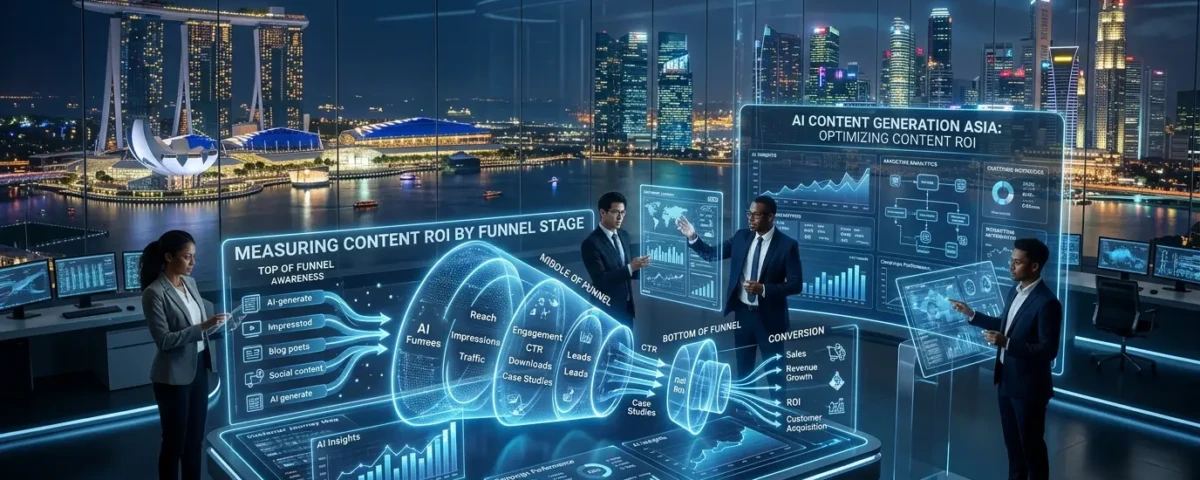
The smartest brands across Asia are moving beyond traffic-based reporting. Instead, they evaluate ROI according to where content influences customer decisions. Top-funnel content builds awareness. Middle-funnel content nurtures trust and consideration. Bottom-funnel content drives revenue and conversions.
When each stage is measured differently, the true impact of content becomes visible.
For organizations embracing AI Content Generation Singapore, this shift is becoming essential. The companies that win are not necessarily creating the most content. They are measuring content performance more intelligently and aligning every asset with a specific business outcome.

Stop Chasing Traffic: Measuring Awareness Where Growth Actually Begins
Awareness is the stage most marketers focus on because the numbers are easy to see.
Traffic.
Impressions.
Views.
Reach.
However, awareness content serves a specific purpose. It introduces your brand to people who may not know you exist. Its role is not immediate conversion. Its role is visibility.
Top-of-funnel content includes educational blogs, industry insights, thought leadership articles, trend reports, social media content, and informational videos. These formats help brands establish credibility while attracting new audiences. Awareness-stage metrics typically include impressions, organic traffic, share of voice, social reach, and branded search growth.
This is where AI Content Generation Singapore delivers substantial value.
Instead of producing five articles per month, businesses can generate dozens of strategically optimized assets targeting different industries, markets, languages, and customer segments across Asia.
The key is understanding what success looks like at this stage.
If a blog receives 10,000 visits but generates no sales this month, that does not necessarily mean it failed. Awareness content often creates delayed value. Buyers may discover your company today but engage with your sales team months later.
Therefore, successful awareness measurement should focus on:
- Organic traffic growth
- New visitor acquisition
- Brand visibility
- AI search citations
- Audience expansion
- Share of voice
Businesses implementing AI Content Generation Singapore should treat awareness content as a long-term investment. The objective is not immediate revenue. The objective is becoming visible wherever potential buyers begin their research journey.
In Asia’s highly competitive digital landscape, visibility often determines whether a company enters the buying conversation at all.

Engagement Is the New Currency: Measuring Mid-Funnel Content Performance
Once awareness is established, the next challenge emerges.
Trust.
A prospect who discovers your brand rarely purchases immediately. They begin comparing alternatives, evaluating solutions, researching competitors, and seeking evidence that your organization can solve their problem.
This is the middle of the funnel.
Industry research consistently shows that comparison content, educational resources, and buyer-focused evaluation assets often generate some of the strongest pipeline impact because they help prospects move from curiosity to consideration.
For companies leveraging AI Content Generation Singapore, this stage represents one of the highest ROI opportunities.
Middle-funnel content includes:
- Case studies
- Comparison guides
- Whitepapers
- Webinars
- Industry reports
- Email nurturing sequences
- Product explainers
Unlike awareness content, engagement becomes the primary measurement objective.
Metrics should include:
- Time on page
- Scroll depth
- Returning visitors
- Lead magnet downloads
- Webinar registrations
- Email subscriptions
- Marketing-qualified leads
The goal is to determine whether prospects are actively progressing toward a buying decision.
Organizations utilizing AI Content Generation Singapore can rapidly create personalized content journeys tailored to different industries, buyer personas, and geographic markets throughout Asia.
This level of personalization increases relevance and often improves engagement rates significantly.
The strongest content strategies do not simply attract visitors. They guide visitors through a structured learning journey that reduces uncertainty and builds confidence.
That confidence is what ultimately creates pipeline.

Revenue Is the Scoreboard: Measuring Bottom-Funnel Content ROI
Traffic creates visibility.
Engagement creates interest.
Revenue creates proof.
Bottom-of-funnel content is where marketing efforts become directly connected to business outcomes. This is the stage where prospects evaluate final options and decide whether to buy.
Unfortunately, many companies invest heavily in awareness content while neglecting conversion-focused assets. Yet evidence suggests that decision-stage content often produces the highest measurable ROI because it directly influences purchasing decisions.
For businesses implementing AI Content Generation Singapore, bottom-funnel measurement should focus on:
- Qualified opportunities
- Conversion rates
- Sales pipeline value
- Customer acquisition cost
- Revenue attribution
- Closed deals
Examples of high-performing bottom-funnel content include:
- Customer success stories
- ROI calculators
- Product demonstrations
- Competitive comparisons
- Proposal support materials
- Buying guides
This is where content moves from being a marketing asset to becoming a revenue asset.
Using AI Content Generation Singapore, companies can quickly create highly targeted sales-enablement content that supports prospects during final decision-making stages.
When measured correctly, organizations can identify exactly which content pieces influence revenue generation.
Instead of asking:
“How many people read this article?”
The question becomes:
“How much revenue did this content help generate?”
That shift changes everything.
Because business leaders care less about clicks and more about growth.
Attribution Matters More Than Content Volume
Creating more content does not automatically create more ROI.
Understanding attribution does.
One of the biggest challenges in modern marketing is determining which content influenced a purchase. Buyers consume multiple pieces of content before making a decision. They may read a blog, download a guide, attend a webinar, watch a video, and then request a demo.
Which asset deserves credit?
The answer depends on your attribution model.
Organizations using AI Content Generation Singapore need attribution frameworks capable of tracking customer journeys across multiple channels and touchpoints.
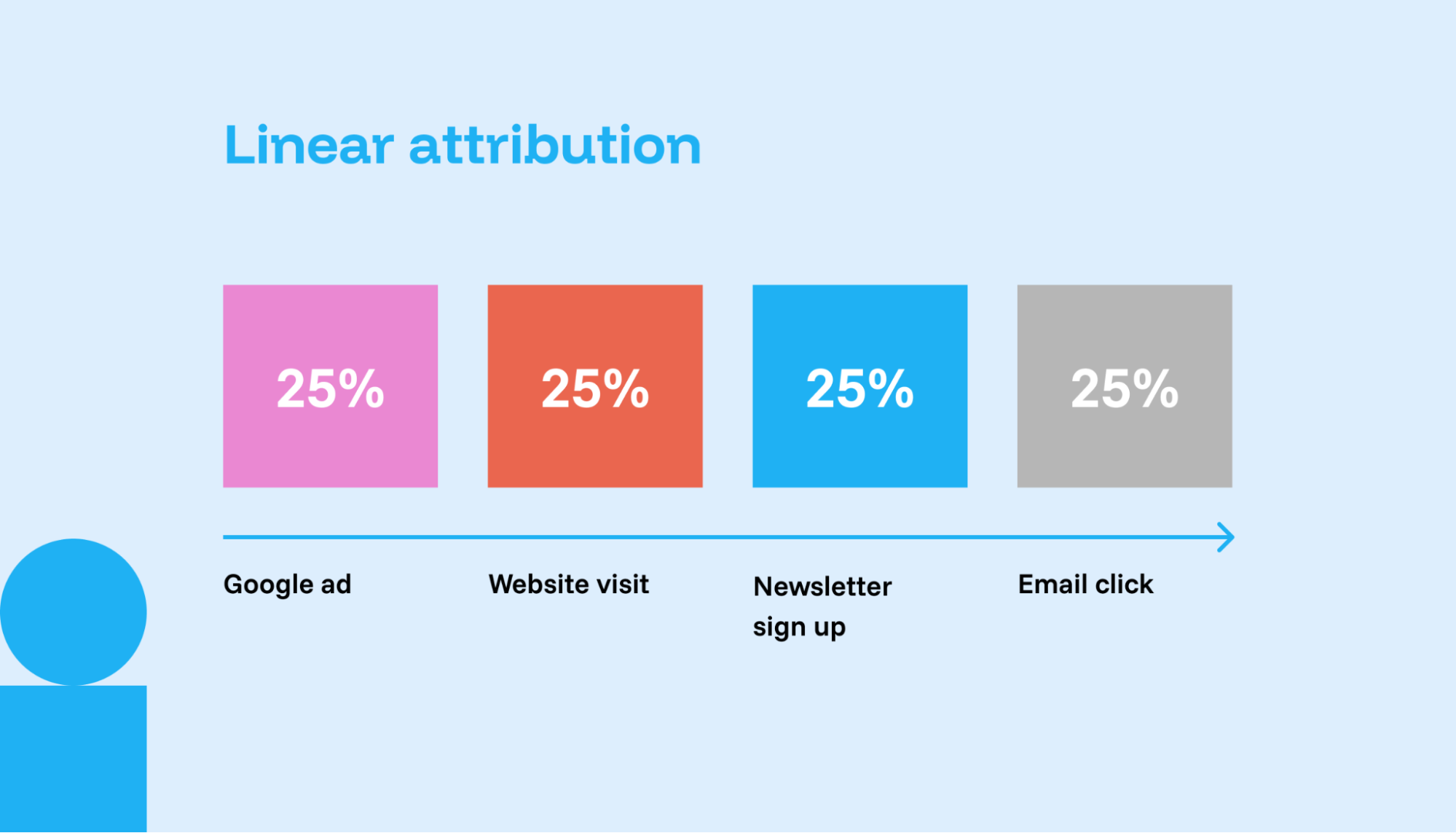
Common attribution models include:
- First-touch attribution
- Last-touch attribution
- Multi-touch attribution
- Position-based attribution
Multi-touch attribution generally provides the most realistic picture because modern buyer journeys rarely follow a straight line. Buyers often interact with content repeatedly before purchasing.
By integrating analytics platforms, CRM systems, and marketing automation tools, businesses can trace content influence across the entire funnel.
This is particularly important when scaling AI Content Generation Singapore.
Without attribution, teams may incorrectly eliminate content that appears underperforming but actually contributes significantly to conversions later in the customer journey.
Attribution transforms content measurement from guesswork into strategic intelligence.
The result is smarter investment decisions and stronger marketing efficiency.

Beyond Leads and Traffic: The Advanced ROI Metrics Leaders Track
Sophisticated organizations no longer stop at traffic and leads.
They measure business impact.
As AI-powered marketing matures, advanced ROI metrics are becoming increasingly important. Companies want to understand not only whether content generates leads but whether it improves profitability, retention, and operational efficiency.
Organizations using AI Content Generation Singapore should consider tracking:
- Customer Lifetime Value (CLV)
- Customer retention rates
- Repeat purchase behavior
- Content production efficiency
- Cost savings from AI automation
- Revenue per content asset
AI dramatically changes content economics.
A content strategy that previously required large teams and lengthy production cycles can now operate with significantly greater efficiency. Research and industry adoption increasingly show substantial productivity gains when AI supports content workflows.
This means ROI should not only be measured through revenue generation.
It should also be measured through operational improvement.
If AI reduces production costs while maintaining or improving performance, ROI increases even before additional revenue is generated.
Businesses investing in AI Content Generation Singapore should evaluate both growth metrics and efficiency metrics to obtain a complete understanding of content performance.
The future belongs to organizations that optimize both outcomes simultaneously.
Conclusion
The era of measuring content by traffic alone is ending.
Modern buyers move through complex journeys. They discover brands through AI search, consume multiple content formats, compare alternatives, seek validation, and often make purchasing decisions long before speaking with a sales representative.
As a result, content measurement must evolve.
Organizations investing in AI Content Generation Singapore need frameworks that evaluate awareness, engagement, consideration, conversion, and retention separately.
Each funnel stage serves a different purpose.
Each requires different KPIs.
Each contributes unique business value.
The companies generating the strongest results across Asia are not necessarily publishing the most content. They are measuring content against business outcomes at every stage of the funnel.
Awareness content builds visibility.
Engagement content builds trust.
Conversion content generates revenue.
Retention content increases lifetime value.
Together, they create a complete content ecosystem that supports sustainable growth.
For businesses embracing AI Content Generation Singapore, the opportunity is clear.
Create strategically.
Measure intelligently.
Optimize continuously.
Because content is no longer just a marketing activity.
When measured correctly, it becomes one of the most powerful revenue-generating assets in the entire organization.
