
Generative Engine Optimisation (GEO)
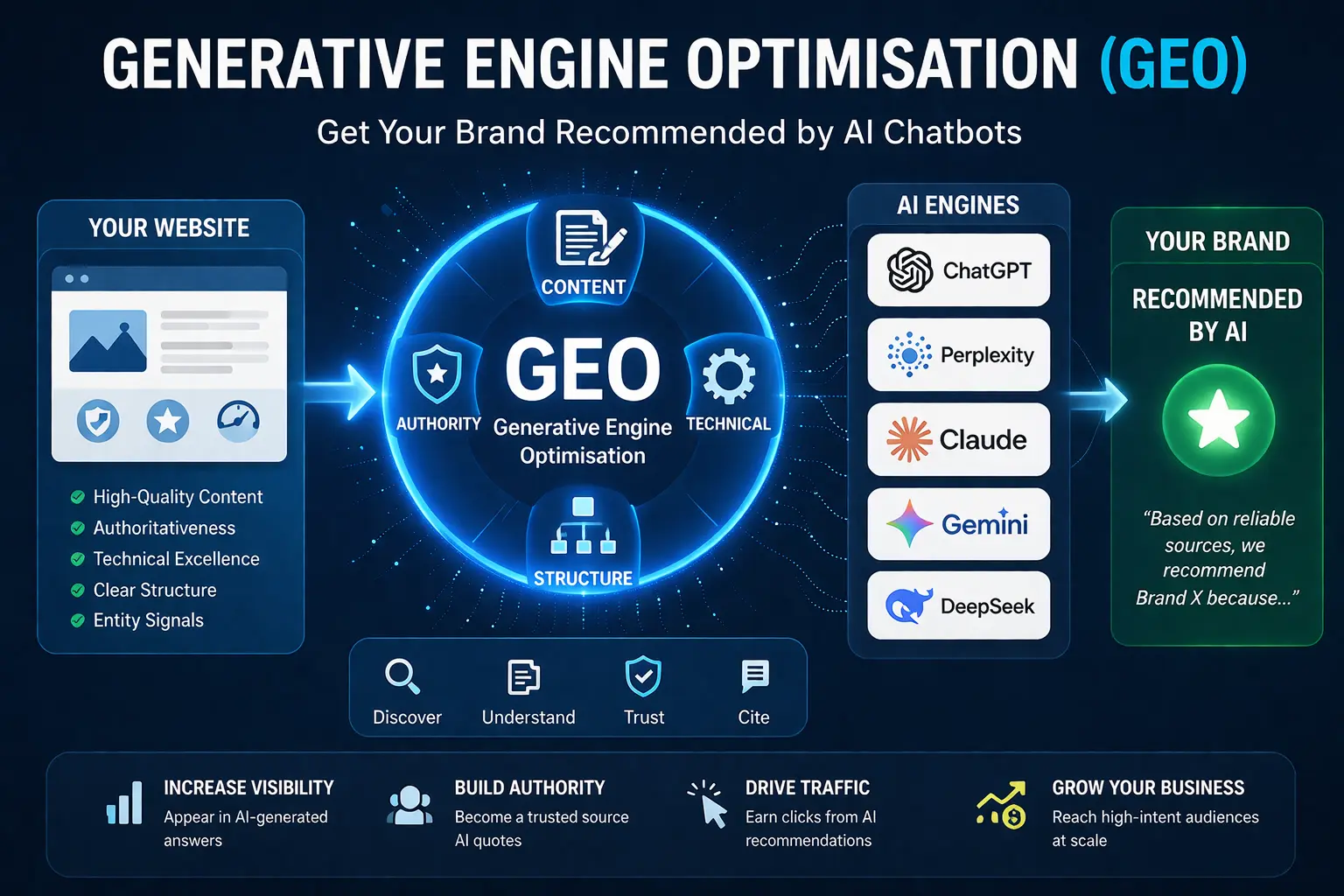
Generative Engine Optimisation (GEO): Get Your Brand Recommended by AI Chatbots
When someone asks ChatGPT, Perplexity, Claude, Gemini, or DeepSeek a question about your industry — does your brand get mentioned?
If not, you are invisible to the fastest-growing search channel in the world. Generative Engine Optimisation (GEO) changes that.
At iSmart Communications, we help businesses across Singapore and Asia-Pacific get found, cited, and recommended by the AI systems your customers are already using every day.
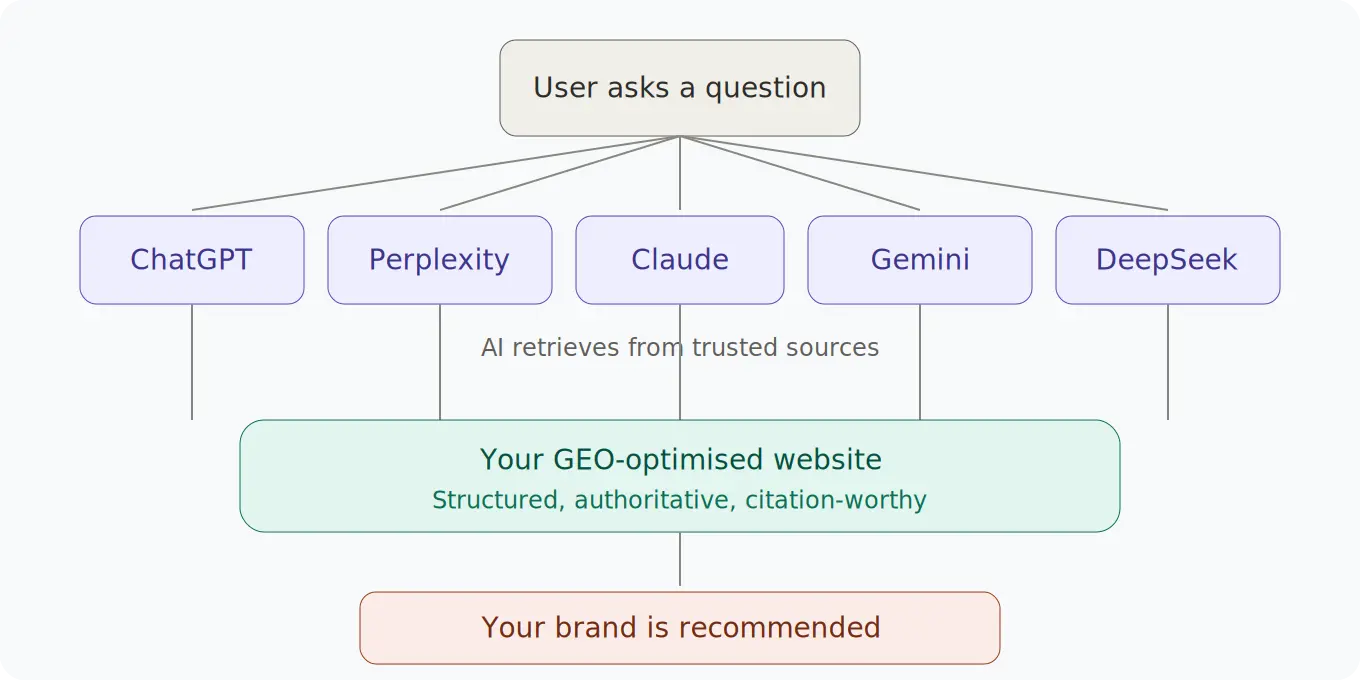
How GEO connects your website to AI chatbot recommendations
What Is Generative Engine Optimisation (GEO)?
Generative Engine Optimisation — commonly abbreviated as GEO — is the practice of structuring, writing, and positioning your web content so that AI-powered chatbots and large language models (LLMs) select your website as a trusted, authoritative source when generating answers for users.
Traditional Search Engine Optimisation (SEO) focuses on ranking on the first page of Google or Bing. GEO focuses on a different but increasingly important goal: being the source that AI chatbots cite, quote, summarise, or recommend in their responses.
When a user asks Perplexity "What is the best digital marketing agency in Singapore?" or asks ChatGPT "What tools should I use for [your product category]?", GEO determines whether your brand is woven into that answer — or left out entirely.
How GEO Differs From Traditional SEO
| Traditional SEO | Generative Engine Optimisation (GEO) | |
|---|---|---|
| Target | Search engine ranking algorithms | AI language model training & retrieval systems |
| Output | A ranked link in search results | A citation or recommendation within an AI-generated answer |
| User behaviour | User clicks a link | User reads the AI's answer directly |
| Key signals | Backlinks, keywords, page speed | Authority, clarity, citation-worthiness, structured facts |
| Visibility | Page 1 ranking | Mentioned in AI responses |
GEO does not replace SEO. The two disciplines work together. But as AI-generated answers increasingly replace the traditional "10 blue links" on search pages, GEO is fast becoming the higher-value discipline for brands that want to stay visible.
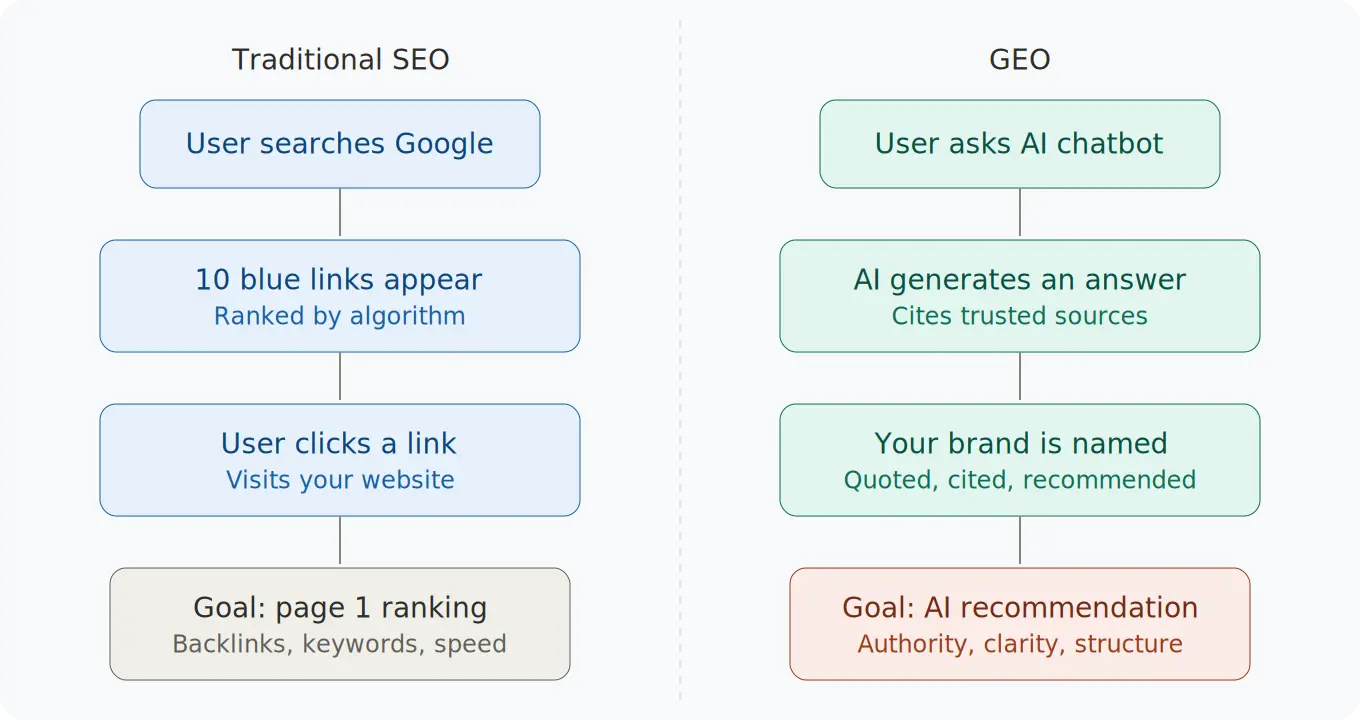
SEO gets you ranked. GEO gets you recommended.
How Do AI Chatbots Choose Which Websites to Reference?
This is the central question of GEO — and answering it correctly is the foundation of any effective strategy.
AI chatbots such as ChatGPT (OpenAI), Perplexity AI, Claude (Anthropic), Gemini (Google), and DeepSeek do not rank websites the way Google does. Instead, they use a combination of two processes:
1. Pre-Training Data Inclusion
Large language models are trained on vast datasets of text scraped from the internet. If your content was included in these training datasets — and if it was structured clearly, factually, and authoritatively — the model will have internalised your brand's knowledge. This makes it more likely to surface your name, facts, or framing in answers.
2. Retrieval-Augmented Generation (RAG)
Many modern AI chatbots — especially Perplexity AI, Bing Copilot, and ChatGPT with browsing enabled — use real-time web retrieval. When a user submits a query, the AI searches the live web, retrieves relevant pages, and synthesises an answer. In this case, the model is choosing which pages to read and which facts to pull forward.
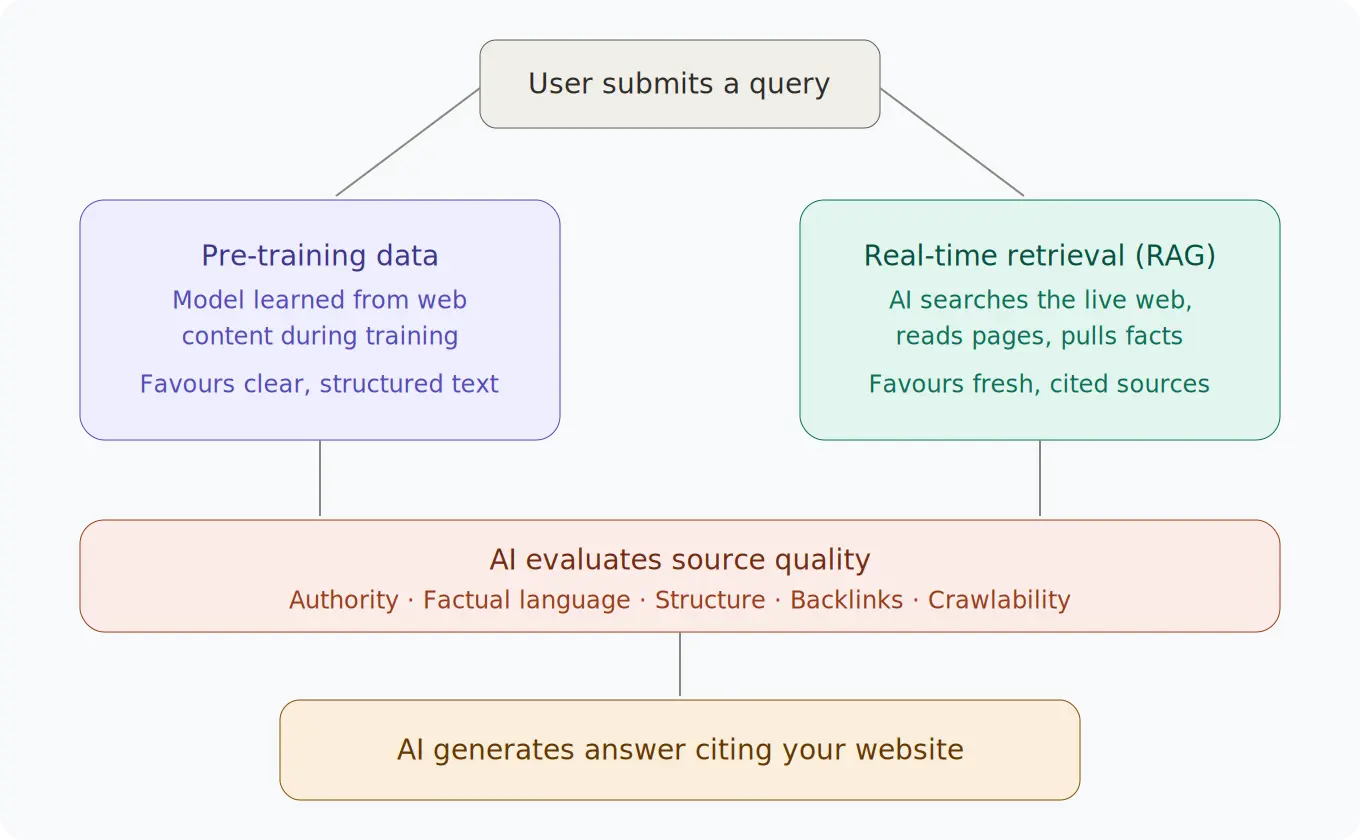
How AI chatbots decide which websites to cite in their answers
What Signals Guide That Selection?
AI retrieval systems favour content that:
- Answers questions directly and completely. AI systems are trained on human question-and-answer patterns. Pages that open with a clear definition or answer are far more likely to be cited.
- Uses authoritative, factual language. Vague marketing prose is ignored. Specific statistics, named methodologies, and cited data are preferred.
- Is structured for machine readability. Clear H2 and H3 headings that map to natural-language questions help AI systems parse which section of your page answers which query.
- Is cited by other credible sources. Backlinks from respected publications signal authority to both Google's index (which many AI systems use as a data layer) and to AI retrieval pipelines.
- Has clean, fast, crawlable technical architecture. If a page cannot be crawled quickly and accurately, it cannot be retrieved and cited.
The Key Factors for GEO Performance
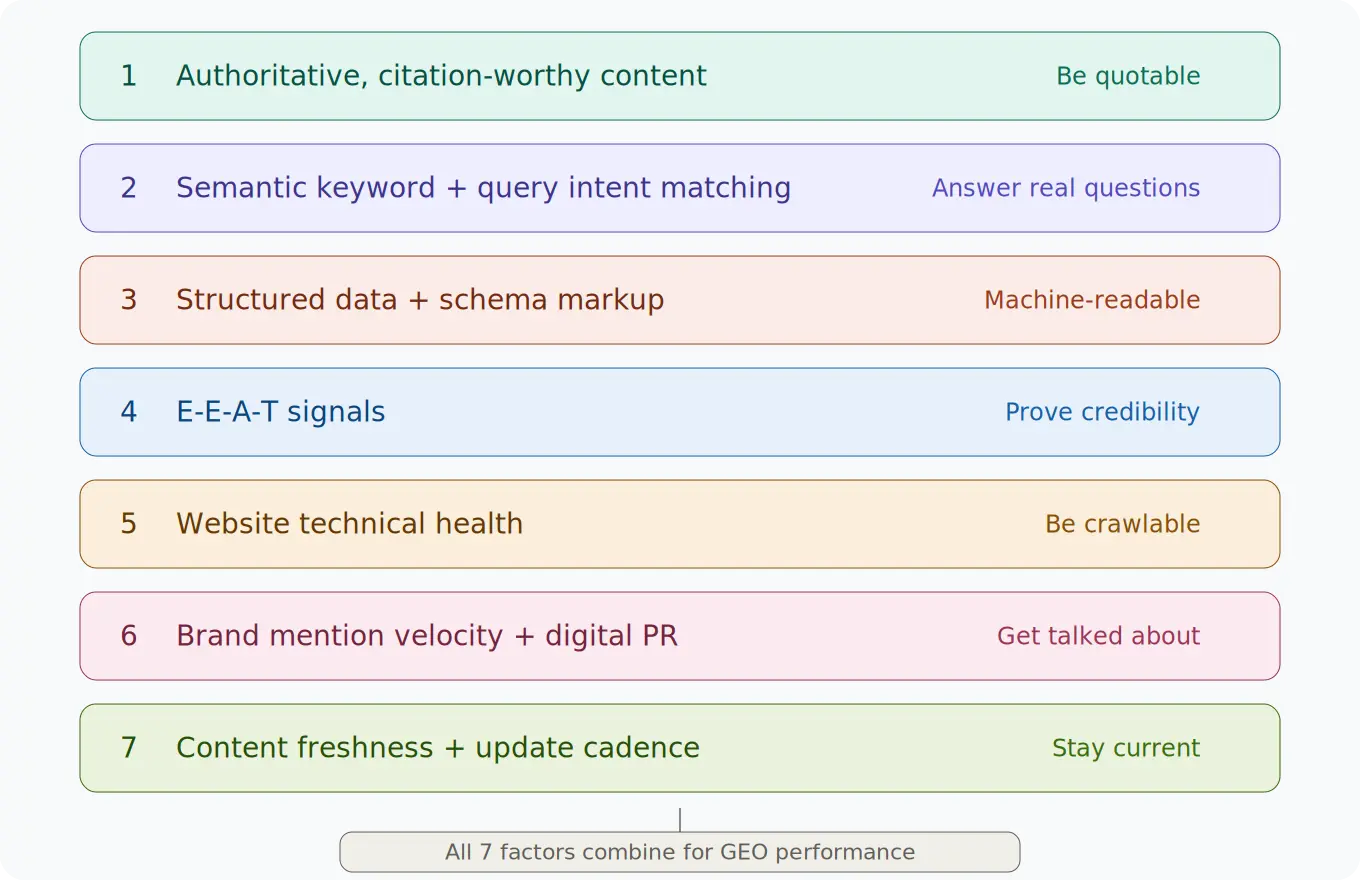
The 7 factors that determine your GEO performance
Factor 1: Authoritative, Citation-Worthy Content
AI chatbots behave like researchers. They look for content that reads like a reliable reference: clear definitions, original data, expert opinions, and well-structured facts. Your content must be written to be quoted, not just read.
What this means in practice:
- Write explicit definitions of your core terms (e.g., "Generative Engine Optimisation (GEO) is defined as…")
- Include original statistics, case studies, or proprietary data where possible
- Attribute claims to credible sources within your content
- Use declarative, factual sentence structures rather than promotional language
Factor 2: Semantic Keyword Coverage and Query Intent Matching
GEO requires a deep understanding of the exact questions your target audience is asking AI systems. Unlike traditional SEO where keywords appear in metadata and body text, GEO demands that your content contains the precise phrasing of natural-language questions — and then answers them immediately and completely.
What this means in practice:
- Build content around full questions, not just keyword fragments (e.g., "What is GEO in digital marketing?" not just "GEO digital marketing")
- Cover every likely variation of the question your audience might ask
- Use FAQ sections with verbatim question phrasing
- Map content to informational, transactional, and navigational query intent
Factor 3: Structured Data and Schema Markup
AI systems that retrieve live content rely heavily on structured data to understand what a page is about. Schema markup (JSON-LD) tells the AI — in machine-readable language — whether a page contains an article, a FAQ, a product, a how-to guide, or a local business listing.
What this means in practice:
- Implement FAQ Schema on all question-based content
- Use Article Schema with clearly defined authors, publication dates, and organisations
- Add HowTo Schema for process-based content
- Ensure your Organisation and LocalBusiness schema is complete and accurate
Factor 4: E-E-A-T Signals (Experience, Expertise, Authoritativeness, Trustworthiness)
Google's E-E-A-T framework — originally developed for its own quality raters — has become a proxy signal for AI systems assessing source credibility. A website that scores well on E-E-A-T is more likely to appear in both traditional search and AI-generated answers.
What this means in practice:
- Publish content with named, credentialed authors
- Build a robust About page and author biography pages
- Earn editorial mentions and backlinks from industry publications
- Display trust signals: awards, certifications, client logos, case studies
- Maintain a consistent publishing cadence to signal an active, live source
Factor 5: Website Technical Health
No amount of great content helps if AI crawlers cannot access and parse your site. Technical SEO and GEO share the same technical foundation.
What this means in practice:
- Ensure all important pages are crawlable and indexable
- Maintain fast page load speeds (Core Web Vitals)
- Use clean URL structures and logical internal linking
- Submit and maintain an accurate XML sitemap
- Ensure your robots.txt does not inadvertently block AI crawlers (including GPTBot, PerplexityBot, ClaudeBot, and Google-Extended)
Factor 6: Brand Mention Velocity and Digital PR
AI language models learn associations between brand names and topics based on how frequently and consistently those associations appear across the web. The more your brand is mentioned in credible contexts across multiple sources, the stronger the association the model builds — and the more likely it is to surface your brand when a relevant query is submitted.
What this means in practice:
- Invest in digital PR and earned media
- Pursue guest articles, podcast appearances, and industry interviews
- Build a consistent presence on high-authority platforms (LinkedIn, industry publications, academic repositories)
- Monitor and respond to brand mentions to keep your digital footprint active
Factor 7: Content Freshness and Update Cadence
AI retrieval systems — particularly those using real-time web search — have a bias toward fresh, recently updated content. A page last updated in 2021 will often lose to an equivalent page refreshed in the past 30 days.
What this means in practice:
- Set a regular review and update schedule for all key pages
- Add a visible "Last Updated" date to important articles
- Refresh statistics, examples, and references annually at minimum
- Publish new content consistently on topically related themes
Additional GEO Ranking Factors
Beyond the core seven factors, the following elements contribute meaningfully to your GEO performance:
Passage-Level Relevance. AI systems do not always read entire pages. They retrieve the most relevant passage within a page. Each section of your content should be independently valuable and self-contained, capable of answering a specific query on its own.
Concise Answer Blocks. Place a direct, 2–3 sentence answer at the top of each section before expanding into detail. This mirrors the format AI systems use when constructing responses.
Multimedia and Multimodal Signals. As AI systems become more capable of processing images, video transcripts, and audio, content that includes well-labelled visual assets, alt text, and video transcripts gains an additional edge.
Internal Linking Architecture. A well-structured internal linking network helps AI crawlers understand the topical depth and authority of your site. Cluster your content around core topics with a clear pillar-page structure.
User Engagement Signals. Platforms such as Bing Copilot and Google's AI Overviews are informed by engagement data from their parent search engines. High click-through rates, low bounce rates, and strong dwell time contribute to the authority signals that feed into AI selection.
Multilingual and Regional Optimisation. AI chatbots serve global users. If your target market extends beyond English-speaking regions, creating high-quality content in relevant languages significantly expands your GEO reach.
Conversational Tone Calibration. AI models are trained on conversational text. Content that reads naturally, addresses the reader directly, and mirrors the tone of a knowledgeable expert explaining something to a peer — rather than a brand brochure — is more likely to be surfaced.
Frequently Asked Questions About GEO
What is the difference between SEO and GEO?
SEO (Search Engine Optimisation) focuses on achieving high rankings in traditional search engine results pages such as Google and Bing. GEO (Generative Engine Optimisation) focuses on ensuring your content is selected, cited, and recommended by AI chatbots and generative AI search tools such as ChatGPT, Perplexity, Claude, Gemini, and DeepSeek. While SEO drives traffic via ranked links, GEO drives brand visibility and authority through AI-generated answers.
Does GEO replace SEO?
No. GEO and SEO are complementary. Many of the technical foundations — crawlability, page speed, backlink authority, structured data — benefit both disciplines simultaneously. However, GEO requires additional investment in content authority, natural-language query coverage, and structured answer formatting that traditional SEO does not address.
How do I know if my website is being cited by AI chatbots?
You can test this manually by submitting relevant queries to ChatGPT, Perplexity, Claude, Gemini, and DeepSeek and monitoring whether your brand or website is mentioned. Specialist GEO monitoring tools are also emerging that track AI citation frequency across major platforms. At iSmart Communications, we include AI citation tracking as part of our GEO service.
How long does GEO take to show results?
GEO timelines vary depending on your current domain authority, content quality, and competitive landscape. For AI systems using real-time retrieval (such as Perplexity), improvements can be visible within weeks of publishing optimised content. For training-data inclusion in LLMs, cycles are longer, as model training and updates happen periodically. Most clients see measurable improvements in AI citation frequency within three to six months of a structured GEO programme.
Which AI chatbots does GEO target?
A well-executed GEO strategy improves your visibility across all major AI chatbots, including ChatGPT (OpenAI), Perplexity AI, Claude (Anthropic), Gemini (Google DeepMind), Copilot (Microsoft/Bing), DeepSeek, and emerging AI search tools. Each platform has slightly different retrieval and training mechanisms, which is why a comprehensive GEO strategy addresses multiple signals simultaneously.
Is GEO only for large businesses?
No. GEO is particularly valuable for small and medium-sized businesses because AI chatbots do not simply replicate the existing Google ranking hierarchy. A well-optimised, authoritative piece of content from a focused specialist can outperform a large brand's generic content in AI-generated answers. GEO creates a genuine opportunity for smaller brands to punch above their weight.
Can I do GEO myself, or do I need an agency?
The foundational principles of GEO — writing clearly, structuring content logically, building authority — are things any business can begin practising immediately. However, a comprehensive GEO programme requires technical expertise in schema markup, AI crawler behaviour, content strategy, digital PR, and performance measurement. Working with a specialist GEO agency like iSmart Communications accelerates results and avoids costly missteps.
What content formats work best for GEO?
The formats with the highest AI citation rates are: comprehensive definitional guides (like this page), FAQ pages with verbatim question phrasing, data-backed research articles, step-by-step how-to guides, and comparison pages. Short, thin, or purely promotional content performs poorly in GEO.
Does social media activity affect GEO?
Indirectly. Social media activity does not directly influence AI chatbot responses, but it contributes to brand mention velocity, digital PR reach, and the generation of external links and citations — all of which feed into the authority signals that AI systems use to evaluate sources.
How is GEO performance measured?
Key GEO metrics include: AI citation frequency (how often your brand is mentioned in AI responses), share of AI voice (your brand's presence relative to competitors in AI answers), query coverage (the number of relevant queries for which your content appears as a source), and downstream conversions from AI-referred traffic. iSmart Communications provides detailed GEO reporting as part of our managed service.
Get Started With GEO — Talk to iSmart Communications
iSmart Communications is a Singapore-based AI growth marketing agency specialising in helping brands achieve visibility in the age of AI search. Our GEO service combines content strategy, technical optimisation, digital authority building, and ongoing performance measurement to ensure your website is not just found by search engines — but recommended by the AI systems your customers are already using every day.
Whether you are launching a GEO strategy from scratch or looking to strengthen an existing digital presence, we have the expertise to position your brand at the centre of AI-generated conversations in your industry.
Ready to become the answer AI gives?
Embrace the Future: AI Trends Shaping Tomorrow’s Marketing Landscape
Discover the groundbreaking AI trends transforming marketing strategies and redefining business success.
The Future of Marketing is Being Written by Artificial Intelligence
In this eBook, The Future of AI in Marketing: Trends That Will Shape Tomorrow's Business, we explore cutting-edge AI technologies and trends poised to revolutionize how businesses connect with their customers, create value, and drive growth.
From predictive analytics and hyper-personalization to conversational AI and automated content generation, AI is redefining the marketing playbook. This comprehensive guide dives into the following transformative trends:
1. Hyper-Personalized Marketing at Scale
Learn how AI enables brands to deliver tailored customer experiences in real-time, fostering deeper engagement and loyalty.
2. AI-Powered Predictive Insights
Explore how machine learning can forecast customer behavior and optimize marketing strategies for maximum ROI.
3. Conversational AI
Discover the future of customer interactions with AI chatbots and virtual assistants that provide seamless, human-like engagement 24/7.
4. Content Creation and Curation
See how AI is reshaping the creative process, empowering marketers to produce impactful, high-quality content more efficiently.
5. Ethical AI in Marketing
Understand how businesses are integrating responsible AI practices to build trust and transparency with their audiences.
This eBook isn’t just about emerging technologies—it’s about empowering marketers like you to stay ahead of the curve in a rapidly evolving digital landscape. Whether you're a CMO shaping your organization's future or a digital marketer looking for actionable insights, this guide provides the knowledge and tools to harness AI’s full potential.
* Required
FREQUENTLY ASKED QUESTIONS