

AI Content Generation Asia: How to Scale Content Across Markets
May 11, 2026 at 6:42 pm
B2B Lead Generation for Singapore: LinkedIn Campaign Blueprint
May 14, 2026 at 11:28 pm

Most brands today are not short on AI tools. They are drowning in them. Yet only a fraction understand what real AI maturity looks like in marketing. The difference is subtle but dangerous: using AI versus building with AI. One is tactical convenience. The other is strategic evolution.
Across Asia, especially in competitive hubs like Singapore, businesses are rushing into automation without a framework. They automate content, generate ads, and deploy chatbots—but still operate with fragmented intelligence. This is where the maturity gap begins to widen. And in that gap, performance either compounds or collapses.
A true AI Marketing Agency Singapore does not treat AI as a toolset. It treats it as an operating system. It doesn’t ask “what can AI do?” It asks “what should AI decide?”
The harsh reality is this: most brands are stuck in early-stage experimentation, mistaking activity for progress. Meanwhile, competitors who understand structured maturity are building scalable, data-driven ecosystems that learn and adapt in real time.
Another layer emerges when businesses attempt to scale without alignment. Even advanced teams often fall into the trap of disconnected AI usage—copy here, analytics there, automation somewhere else. Without cohesion, AI becomes noise instead of leverage.
This is why frameworks like the AI Marketing Maturity Model matter. They separate operational curiosity from strategic intelligence. And in markets shaped by speed, such as Southeast Asia, that distinction defines survival.
Leading firms such as AI Marketing Agency Singapore understand this shift deeply. They don’t implement AI for novelty. They architect it for compounding advantage.
And this is the real question every brand must face: are you adopting AI… or are you evolving with it?

Understanding the AI Marketing Maturity Model: From Tools to Intelligence Systems
The AI Marketing Maturity Model is not about how many tools you use. It is about how deeply AI is embedded into your decision-making architecture. Most organizations confuse automation with intelligence. But automation without structure is just speed without direction.
At its core, the model measures how marketing evolves from human-driven execution to AI-augmented decision ecosystems. Early stages rely heavily on manual effort, while advanced stages shift toward predictive and autonomous systems that continuously optimize performance.
Brands working with an experienced AI Marketing Agency Singapore often discover that their real limitation is not technology—it is structure. Without a maturity model, AI tools remain isolated assets rather than interconnected intelligence layers.
The model typically evolves across five stages: manual execution, assisted marketing, systemized workflows, optimized intelligence, and finally AI-native ecosystems. Each stage represents not just capability growth, but mindset transformation.
At lower levels, AI is reactive. It assists with content generation, reporting, and basic automation. At higher levels, AI becomes proactive. It predicts customer behavior, adjusts campaigns in real time, and identifies opportunities before humans recognize them.
This shift requires more than adoption—it requires redesigning how marketing decisions are made. Data stops being descriptive and becomes prescriptive. Campaigns stop being static and become adaptive systems.
The challenge most brands face is overestimating their maturity level. They believe using AI equals being AI-driven. In reality, true maturity is measured by integration depth, not tool count.
Strategic partners like AI Marketing Agency Singapore help brands map this transition properly. They identify gaps between intention and execution, then rebuild systems that allow AI to function as a decision layer, not just a support tool.
Understanding this model is the first step toward escaping operational chaos and moving into structured intelligence.

Level 1–2: Manual Chaos to Assisted Efficiency
At the earliest stage of AI marketing maturity, everything is manual. Campaigns are built from scratch, reporting is time-consuming, and decision-making relies heavily on intuition. There is little to no AI integration beyond basic tools. This is where many brands unknowingly remain trapped.
Level 2 introduces assisted marketing. Here, AI tools start appearing in workflows—copy generation, basic analytics, scheduling automation. But these tools operate in isolation. They improve efficiency but do not improve intelligence.
Many businesses working with an AI Marketing Agency Singapore realize that they are stuck in this hybrid zone. They are faster, but not smarter. They produce more content, but not necessarily better outcomes.
The core issue at this stage is fragmentation. Teams use different tools for different tasks without a unified system. Data lives in silos. Insights are reactive rather than predictive. AI is treated as an assistant, not a strategist.
Another common challenge is over-reliance on output metrics. More posts, more ads, more emails—but not necessarily more impact. Without integration, scale becomes noise.
The shift from Level 1 to Level 2 feels productive, but it is not transformative. It is operational relief, not strategic advancement. And this is where many brands become complacent.
Forward-thinking teams guided by an AI Marketing Agency Singapore begin restructuring their workflows at this stage. They move from tool stacking to system thinking. Instead of asking “what tool should we use?” they ask “how should intelligence flow through our marketing process?”
The difference is subtle but critical. One builds efficiency. The other builds evolution.
Level 3: The Shift to Systemized AI Adoption
At Level 3, marketing stops being a collection of tools and starts becoming a system. This is where real transformation begins. AI is no longer scattered across tasks—it is embedded into workflows.
Campaign management becomes partially automated. Data pipelines connect performance metrics across platforms. Content planning starts to follow predictive patterns based on historical behavior. The organization begins to think in systems rather than campaigns.
Brands working with an AI Marketing Agency Singapore at this stage often experience a structural awakening. They realize that efficiency alone is not enough. The real value lies in connectivity.
However, Level 3 is also where complexity increases. Systems exist, but they are not fully unified. AI tools may be integrated into marketing operations, but they are still dependent on human interpretation for final decisions.
This creates a hybrid tension: automation is present, but intelligence is not fully autonomous. Teams begin to rely on dashboards, but still struggle to turn data into foresight.
The biggest breakthrough at this stage is consistency. Messaging becomes more aligned. Campaign execution becomes more predictable. Data begins to inform creative direction in a meaningful way.
Yet limitations remain. Systems are still reactive to input rather than self-learning. Optimization cycles exist, but they are not continuous.
This is why many organizations plateau here. They mistake systemization for maturity. But in reality, systemization is only the foundation layer of intelligence—not the peak.
To move beyond this stage, brands often need guidance from an experienced AI Marketing Agency Singapore that understands how to transition from structured workflows to adaptive intelligence.
Because systemization is not the destination. It is the threshold.

Level 4: AI-Optimized Marketing Operations
Level 4 is where marketing begins to think. Not metaphorically—but operationally. AI is no longer just executing tasks or organizing systems. It is actively optimizing performance in real time.
Campaigns adjust dynamically based on user behavior. Audience segmentation evolves continuously. Content variations are tested and refined automatically. Decision-making shifts from human-led to AI-augmented intelligence loops.
At this stage, working with an becomes less about implementation and more about refinement. The focus is no longer “how do we use AI?” but “how do we maximize what AI is already learning?”
Predictive analytics becomes central. Brands begin anticipating customer intent rather than reacting to it. Marketing becomes less about pushing messages and more about aligning with emerging demand patterns.
However, this level requires discipline. Without proper governance, optimization can become over-automation. AI may optimize for engagement but not always for strategic outcomes. Human oversight remains critical.
The shift in mindset is significant. Marketers transition from operators to supervisors of intelligence systems. Their role becomes strategic calibration rather than execution.
At this stage, performance gains become exponential. Small improvements in data quality or model training produce large-scale business impact.
Yet even here, most brands are not fully mature. They operate optimized systems, but not fully autonomous ecosystems.
The next leap requires abandoning control in favor of guided autonomy.
Level 5: The AI-Native Marketing Ecosystem
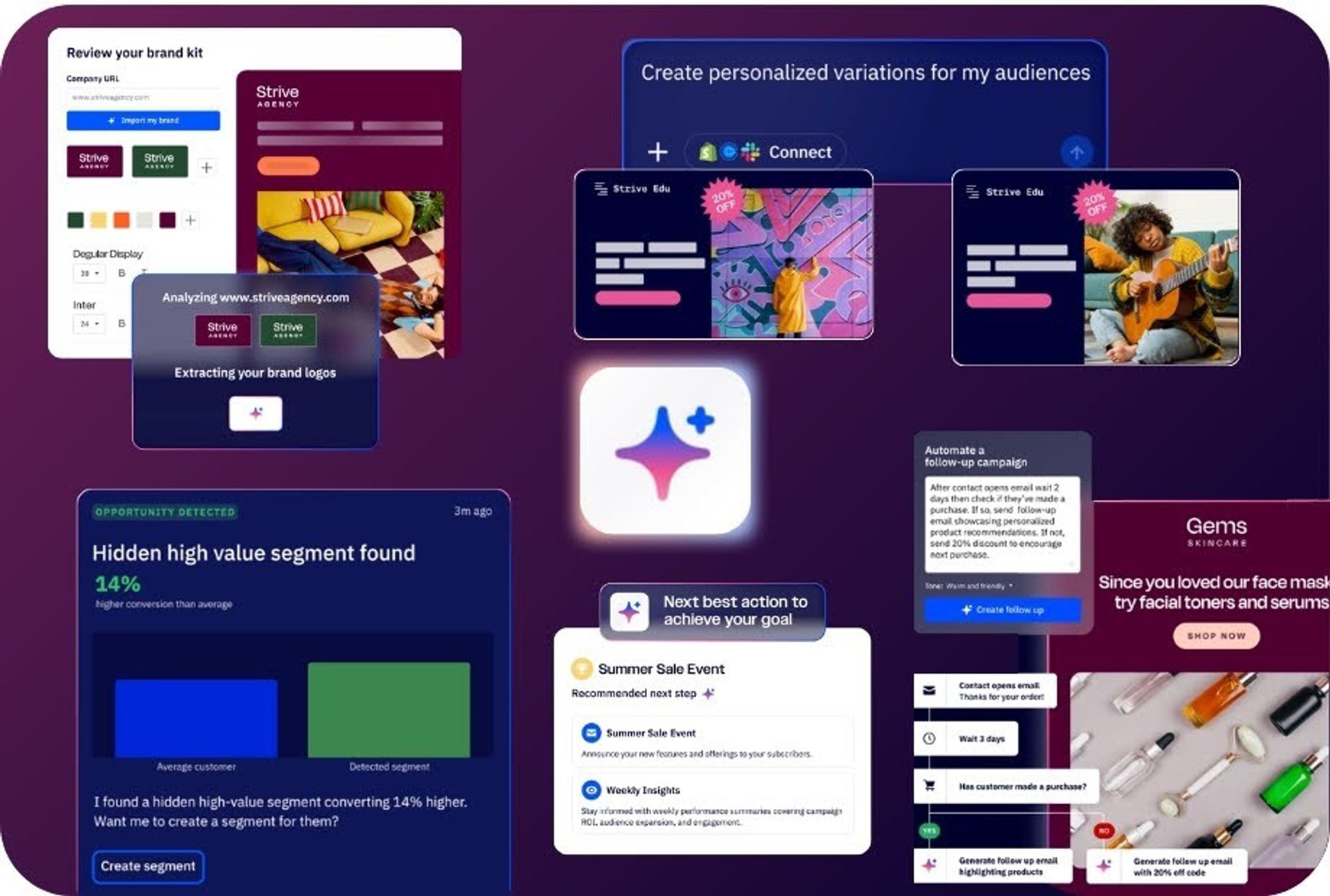
At Level 5, marketing is no longer managed—it is orchestrated. AI is embedded into every layer: strategy, execution, optimization, and forecasting. Systems are not just automated; they are self-learning.
Campaigns evolve without manual intervention. Customer journeys are dynamically constructed in real time. Data is not analyzed after the fact—it continuously shapes future actions.
This is where a truly advanced operates. Not as a service provider, but as an ecosystem architect. The goal is no longer efficiency. It is autonomous intelligence.
At this stage, marketing becomes a living system. Every interaction feeds the model. Every outcome refines future decisions. The organization stops pushing campaigns and starts cultivating adaptive behavior.
The challenge here is trust. Businesses must trust systems that outperform human intuition. This requires a cultural shift as much as a technological one.
Human roles evolve significantly. Strategy becomes meta-level oversight. Creativity becomes directional input into AI systems. Execution becomes minimal, but precision becomes critical.
The real power of Level 5 is compounding intelligence. The system does not just improve—it accelerates its own improvement.
Few organizations reach this stage. Not because it is impossible, but because it requires a fundamental redefinition of marketing itself.
Conclusion: Where Intelligence Becomes Advantage
The AI Marketing Maturity Model is not a theoretical framework. It is a mirror. It shows whether a brand is experimenting with tools or building intelligent systems that scale.
Most organizations overestimate their position. They believe automation equals maturity. In reality, maturity is measured by how independently your marketing system learns, adapts, and improves.
The progression from manual execution to AI-native ecosystems is not linear. It is transformational. Each level requires not just new tools, but new thinking.
Working with an experienced can accelerate this journey, but only if the organization is willing to confront its current limitations honestly.
The uncomfortable truth is this: AI does not fix broken marketing. It amplifies whatever system it is placed into.
So the question is not whether you are using AI. The question is whether your marketing intelligence is evolving—or simply accumulating noise.
Because in the end, maturity is not about adoption. It is about evolution.
