

Why Hiring More Salespeople May Be the Wrong Strategy in the AI Era
August 26, 2026 at 11:39 pm
The Secret to Shortening Your B2B Sales Cycle Using AI
August 27, 2026 at 7:32 pm

For years, B2B companies have treated lead volume as a badge of marketing success. More forms. More downloads. More contacts added to the CRM. More names handed to sales.
But here is the uncomfortable truth: a full CRM does not mean a healthy pipeline.
A sales representative can have hundreds of leads sitting in a database and still struggle to find five prospects genuinely worth calling. The problem is not always lead generation. It is prioritisation.
This is where an AI Marketing Agency Singapore can help businesses rethink how they approach demand generation. Instead of treating every prospect equally, AI can help analyse patterns across customer data, engagement behaviour, company characteristics and historical conversion outcomes to determine which prospects deserve attention first.
That distinction matters because sales capacity is limited. Your team cannot give every prospect the same level of attention without sacrificing productivity. And when salespeople spend their mornings chasing people who downloaded an ebook six months ago, they have less time for the prospect who visited the pricing page twice yesterday and requested a product demonstration.
Modern lead scoring is increasingly moving toward this kind of predictive prioritisation. Research published in 2026 suggests that combining observable company characteristics with predictive ranking can improve both conversion and sales efficiency.
The smarter question is therefore not, “How many leads did marketing generate?”
It is:
“Which leads are most likely to become revenue?”
That is the question AI is increasingly capable of helping sales teams answer.
And once you start asking it, the entire sales process changes.
Not Every Lead Deserves a Sales Call — And That’s a Good Thing
Here is where many sales teams get themselves into trouble: they confuse activity with intent.
Someone downloads a whitepaper. Someone watches a webinar. Someone opens three emails. Someone visits your website.
Suddenly, the CRM assigns points and declares that person a “hot lead.”
But are they actually ready to buy?
Maybe. Maybe not.
Traditional lead scoring often relies on predetermined rules. A webinar might be worth 10 points. A pricing-page visit might be worth 20. A job title might add another 15. Once someone crosses an arbitrary threshold, they are passed to sales.
The problem is that these scores do not necessarily reflect what leads actually become customers.
An AI Marketing Agency Singapore can approach the problem differently by helping businesses connect lead behaviour with actual commercial outcomes.
AI-powered scoring can analyse combinations of signals rather than looking at individual activities in isolation. A pricing-page visit from the wrong company may not mean much. The same visit from a decision-maker at a company matching your ideal customer profile could be far more significant.
Recent research and industry frameworks increasingly emphasise combining fit, intent, engagement quality, recency and historical conversion patterns rather than relying on a single engagement score.
That changes the job of sales.
Instead of calling everyone, representatives can focus their energy on prospects who demonstrate a stronger combination of commercial fit and buying intent.
Lower-priority prospects do not have to disappear. They can be nurtured through automated campaigns until their behaviour changes.
That is the real advantage.
AI does not simply tell you who your leads are.
It helps you decide who deserves your time right now.
AI Can Spot Buying Signals Buried Inside Your Data
The most valuable buying signals are often hiding in plain sight.
A prospect might visit your website repeatedly without filling out a form. Several employees from the same company might consume your content within the same week. A decision-maker might suddenly begin researching the exact problem your service solves.
Individually, these actions can look insignificant.
Together, they can tell a very different story.
This is where AI becomes particularly useful. An AI Marketing Agency Singapore can help businesses build systems that analyse multiple signals across marketing and sales platforms rather than forcing salespeople to manually piece together the story.
AI can evaluate information such as:
- Website behaviour
- Content consumption
- Email engagement
- Form submissions
- Company characteristics
- Job roles and seniority
- Historical customer patterns
- Recency and frequency of engagement
- Account-level activity
- Changes in buying behaviour
The important word is combination.
A single website visit means little. Ten visits from several people at the same company may mean considerably more.
A single content download might represent casual research. Repeated engagement with pricing, product and comparison content could indicate a much stronger buying signal.
Academic research published in 2026 also points toward the value of combining firmographic and behavioural information rather than depending solely on behavioural signals that may appear later in the buying process.
This is the shift from basic automation to intelligence.
Traditional automation asks:
“Did this person do X?”
AI can move the question toward:
“Given everything we know, how does this behaviour compare with the patterns of prospects who actually became customers?”
That is a much more commercially useful question.
Stop Treating a Cold Lead Like a Hot Prospect
One of the biggest hidden costs in B2B sales is not a bad lead.
It is the amount of time spent treating a bad lead like a good one.
Every unnecessary call takes time. Every irrelevant follow-up consumes attention. Every poorly qualified meeting occupies a salesperson’s calendar.
Multiply that across hundreds or thousands of prospects and the cost becomes substantial.
This is why an AI Marketing Agency Singapore can play an important role in designing a more intelligent lead management system.
Imagine your CRM automatically separating prospects into different priority levels.
Your highest-priority prospects might show strong company fit and recent buying behaviour. These leads receive immediate sales attention.
Your middle-tier prospects might fit your ideal customer profile but show weaker intent. They enter personalised nurture campaigns.
Low-priority prospects might have limited commercial fit or minimal engagement. They remain in automated marketing workflows rather than consuming valuable sales capacity.
That is a far more rational use of resources than forcing salespeople to work through a database from top to bottom.
The goal is not to ignore potential customers. It is to match human effort to commercial probability.
AI-assisted lead scoring frameworks increasingly recommend this type of prioritisation, particularly when lead volumes exceed the amount of attention sales teams can realistically provide.
And there is another benefit: speed.
When a genuinely high-intent prospect appears, the system can help surface that opportunity quickly rather than leaving it buried beneath dozens of weaker leads.
Because in B2B, timing matters.
The best lead in your database is not necessarily the one with the highest historical score.
Sometimes it is the one whose behaviour changed today.
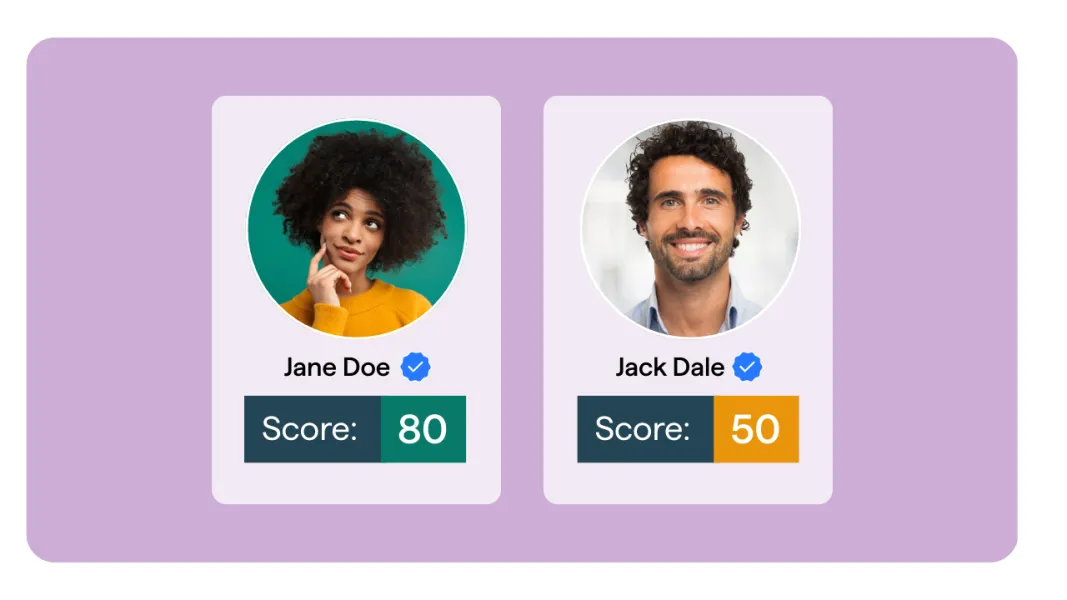
The Smartest Lead Score Combines Fit With Intent
There is a trap in AI-powered lead generation.
Companies can become so fascinated by behavioural data that they forget one fundamental question:
Is this actually the kind of company we want to sell to?
Intent without fit can create a different kind of waste.
Imagine a prospect who visits your website five times, downloads three reports and attends a webinar. Their engagement score looks fantastic.
But their company is too small for your solution.
Or they operate in an industry you do not serve.
Or the person researching your service has no influence over the purchase.
That is not necessarily a great lead.
It is simply an active lead.
An AI Marketing Agency Singapore can help businesses develop a more balanced approach by considering both fit and intent.
Fit can include:
- Industry
- Company size
- Revenue
- Geography
- Job function
- Seniority
- Technology environment
- Ideal customer profile characteristics
Intent can include:
- Recent website activity
- Pricing-page visits
- Product research
- Content engagement
- Demo requests
- Repeat visits
- Account-level engagement
- Buying-related behaviour
The combination is powerful.
A high-fit company with low intent may need nurturing.
A low-fit company with extremely high intent may still not be worth pursuing.
But a high-fit company showing increasingly strong buying behaviour?
That is where sales should pay attention.
Recent B2B scoring frameworks increasingly recommend combining firmographic fit with behavioural and intent signals, rather than relying on engagement alone.
This is where AI becomes more than another dashboard.
It becomes a prioritisation engine.
When AI Filters the Noise, Sales Can Finally Focus on Selling
The real value of AI lead scoring is not the score itself.
Nobody needs another number inside their CRM.
The value comes from what happens after the score is generated.
An AI Marketing Agency Singapore can help connect predictive insights with actual sales and marketing workflows so that prioritisation leads to action.
For example, the system could identify a group of high-potential accounts and automatically route them to the appropriate sales representatives.
At the same time, lower-priority prospects can enter nurture campaigns designed around their interests and behaviour.
Marketing can continue educating them.
Sales can focus on opportunities with stronger signals.
And when a prospect’s behaviour changes, their priority can change with it.
That creates a much more dynamic funnel.
Instead of:
Lead → MQL → Sales → Maybe customer
you move toward:
Data → Intelligence → Prioritisation → Action → Feedback
The feedback loop is critical.
AI should not be treated as an oracle that is always correct. Models depend on the quality of the data, the outcomes being measured and the signals being used. Poor data can simply result in automated bad decisions. Research and practitioner guidance both emphasise the importance of clean inputs, meaningful outcomes and continuous calibration.
Salespeople should also be able to challenge the system.
If the AI consistently ranks the wrong type of account highly, that is not a reason to abandon AI.
It is a reason to improve the model.
The objective is simple:
Give salespeople fewer distractions and better opportunities.
That is what makes AI commercially useful.
Conclusion
The old sales philosophy was built around persistence.
Get more leads. Make more calls. Send more emails. Follow up again. Keep pushing.
But the economics of modern B2B selling are changing.
Your prospects have more information. Your competitors have more automation. Your salespeople have limited time. And your CRM can contain thousands of contacts without necessarily containing thousands of genuine opportunities.
The competitive advantage increasingly comes from knowing where to focus.
An AI Marketing Agency Singapore can help businesses make that transition by connecting AI-powered lead generation, predictive scoring, marketing automation and sales intelligence into a more focused revenue process.
The goal is not to eliminate human judgement.
Quite the opposite.
The goal is to give human judgement better information.
Salespeople should spend less time asking, “Who should I call next?”
They should spend more time asking, “How do I help this prospect solve their problem?”
That is a fundamentally different way of working.
AI can process patterns humans cannot realistically monitor at scale. It can help identify shifts in engagement, compare prospects against historical customer behaviour and prioritise accounts based on combinations of fit and intent. Predictive lead scoring research is increasingly supporting this broader approach to sales prioritisation.
But businesses should resist the temptation to chase AI for its own sake.
The objective is not to build the most sophisticated scoring model.
The objective is revenue.
So stop asking how many leads your marketing team can generate.
Start asking which leads deserve your team’s attention.
Because the next generation of B2B sales will not necessarily belong to the company with the biggest database.
It will belong to the company that knows which opportunities matter most—and acts on them before everyone else does.
