

AI B2B Lead Generation in 2027: From Finding Prospects to Predicting Buying Intent
September 30, 2026 at 5:45 pm
How AI Search Decides Which Businesses to Mention—and Which Ones to Ignore
October 1, 2026 at 10:10 pm
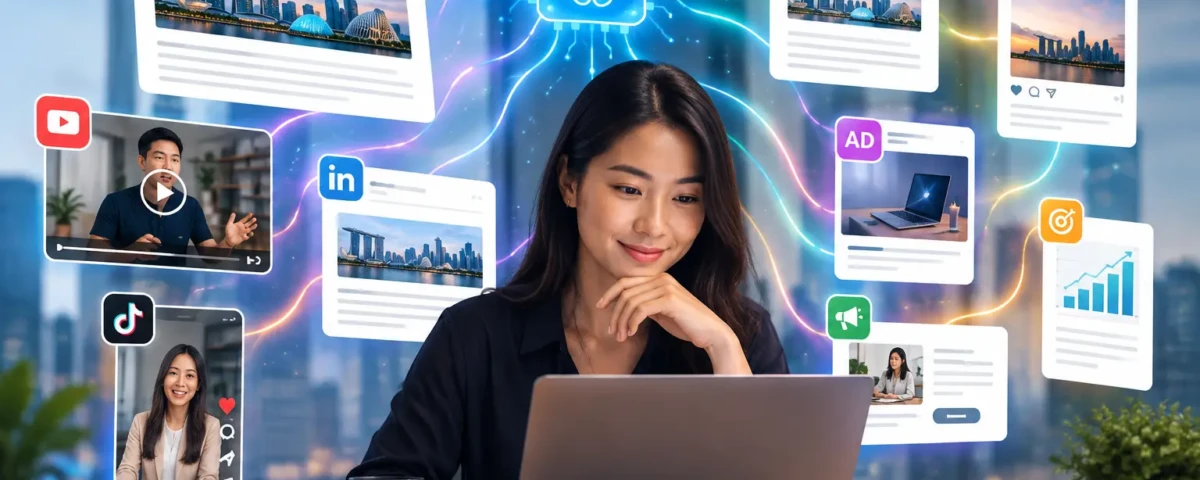
For years, marketers were taught to create one strong piece of content and distribute it everywhere. Write a blog, turn it into a LinkedIn post, publish the same message on Facebook, send it through email, and perhaps create a short video from it. The approach was efficient, but efficiency alone does not make content effective.
The problem is simple: every channel has its own language.
A person searching Google is behaving differently from someone scrolling TikTok. A decision-maker reading LinkedIn is in a different mindset from someone opening a marketing email. A potential customer asking an AI search engine a question is not necessarily looking for the same information as someone watching a 30-second video.
Yet many businesses still create content as though all these audiences are identical.
That is where AI is changing the equation. Modern AI-powered content workflows make it possible to start with one strategic idea and transform it into multiple content experiences without treating every platform as a copy-and-paste destination.
This is where AI Content Generation Singapore becomes increasingly relevant for businesses looking to scale content production without losing strategic direction. AI can help marketers adapt the same underlying message into different formats, structures, tones, and lengths depending on the channel.
The goal is not to create more content simply for the sake of creating more content. The goal is to make every piece of content fit the environment in which it appears.
A blog should answer questions deeply. A LinkedIn post should stimulate professional thinking. A short-form video should capture attention quickly. An email should move the reader toward an action.
The future belongs to marketers who understand that one idea can have many expressions.
One strategy.
Multiple formats.
Smarter distribution.
One Great Idea Can Become an Entire Content Ecosystem
The biggest opportunity created by AI is not simply faster writing. It is the ability to transform one strategic idea into an entire content ecosystem.
Imagine a company has identified an important customer problem: businesses are struggling to generate qualified leads from increasingly fragmented digital channels.
Traditionally, a marketing team might write one blog about the problem and then manually create several social posts around it. That process can take days.
An AI-assisted workflow can approach the same challenge differently.
The original idea becomes the strategic foundation. From there, marketers can develop a long-form article, LinkedIn commentary, short-form videos, email content, social media posts, advertising concepts, visual assets, sales enablement material, and even talking points for a webinar.
The difference is important.
Repurposing should not mean copying.
A 1,500-word article cannot simply be squeezed into a 30-second video. A sales email should not sound like a blog post. A LinkedIn post should not read like an advertisement.
AI allows marketers to reshape the idea instead of merely duplicating the words.
For businesses exploring AI Content Generation Singapore, this shift can fundamentally change how content teams think about production. AI-powered content generation can support text, images, video, advertising creatives, and other formats, creating more opportunities to extend the value of a single strategic concept.
The human marketer still provides the core thinking: the audience problem, positioning, brand perspective, business objective, and desired outcome.
AI then helps multiply that thinking across channels.
This creates a more disciplined content model.
Instead of asking, “What should we post today?”
Marketing teams can ask a much better question:
“What important idea do we want our audience to understand, and how should that idea appear in every channel where they encounter our brand?”
That is a much more strategic approach to content.
Personalization Is Moving Beyond Adding Someone’s Name
Personalization has been part of digital marketing for years, but much of it has remained superficial.
Adding a customer’s first name to an email is technically personalization. Recommending content based on previous behavior is more meaningful. Delivering a different message based on a person’s needs, buying stage, industry, or intent goes further.
AI is making this level of adaptation increasingly practical.
Consider two people visiting the same company website. One may be a marketing manager researching content production. Another may be a senior executive evaluating how AI could reduce marketing costs. They may visit the same pages, but they do not necessarily need the same message.
A smarter content system can account for these differences.
AI can help marketers analyze behavioral signals, customer segments, search intent, engagement patterns, and content interactions. These signals can then inform what type of content should be presented and how the message should be framed.
This is one of the areas where AI Content Generation Singapore can support broader marketing strategies. Content does not have to remain static when the audience changes.
The same core proposition can be explained differently to different people.
A technical audience may want specifications and implementation details. A business leader may want commercial implications. A beginner may need an educational explanation before they are ready to consider a solution.
The message remains strategically consistent, but the presentation changes.
That distinction matters.
Good personalization does not mean creating thousands of completely different campaigns. It means making the content more relevant to the person consuming it.
AI can help marketers achieve this at a scale that would be difficult to manage manually.
But there is a warning.
More personalization does not automatically mean better marketing. If the data is poor, the assumptions are wrong, or the content feels invasive, personalization can work against trust.
The objective should always be relevance.
Not personalization for personalization’s sake.
Stop Distributing Content. Start Delivering Context.
The old marketing mindset focused heavily on distribution.
Create the content.
Publish it.
Push it across channels.
Track impressions.
Repeat.
The smarter approach is increasingly about context.
Where is the audience encountering the message? What are they trying to accomplish? What information do they need at that particular moment? What should happen next?
These questions change the role of content.
A search engine user may need a comprehensive educational article. A person discovering the same topic on TikTok may need a fast explanation of the problem. Someone who has already visited a product page may need a comparison or case study. A sales-qualified prospect may need detailed commercial information.
The underlying subject is identical.
The context is not.
This is why AI Content Generation Singapore should not be viewed simply as an automated writing solution. The larger opportunity is building a content production system capable of adapting ideas to different customer experiences.
AI can help transform a central message into multiple forms while maintaining consistency.
A single campaign could contain a detailed SEO article, several social posts, short-form videos, email sequences, display advertising concepts, presentation graphics, and supporting sales content.
Each asset serves a different purpose.
The blog builds understanding.
The social post creates conversation.
The video captures attention.
The email nurtures interest.
The sales asset helps move a qualified prospect toward a commercial discussion.
This is what makes multichannel marketing more powerful than simply publishing everywhere.
The channels become connected parts of a customer journey instead of isolated publishing platforms.
The objective is no longer maximum distribution.
It is maximum relevance at the right moment.
AI provides the production capabilities to make that approach more achievable, but strategy remains the foundation. Without a clear customer journey, businesses can simply produce more disconnected content at greater speed.
Technology can accelerate a system.
It cannot replace the need for one.
AI Is Turning Content Marketing Into a Connected System
The next major shift is happening behind the scenes.
Content creation is becoming less isolated from the rest of marketing.
In traditional workflows, the SEO team might work separately from social media. The content team might operate independently from paid advertising. Email marketing might run on another calendar. Sales may receive content only after it has already been published.
AI creates an opportunity to connect these functions.
A single customer insight can inform multiple marketing activities.
Search behavior can influence content topics. Content engagement can inform audience segmentation. Social interactions can reveal questions that deserve deeper articles. Email engagement can identify topics that deserve additional educational material. Sales conversations can expose objections that marketing should address publicly.
The result is a feedback loop.
Content generates data.
Data informs strategy.
Strategy generates new content.
New content generates more engagement and data.
This is where AI Content Generation Singapore can become part of a wider AI-powered marketing ecosystem. AI content generation can support the production of text, visual content, video, creative assets, and other marketing materials, while connected systems can help marketers organize and deploy those assets across channels.
But businesses should avoid one common mistake: assuming that automation itself is the strategy.
It is not.
Automating a weak content process simply allows a company to produce weak content faster.
The foundation still needs to be solid.
Businesses need clear positioning. They need defined audiences. They need a content strategy tied to business objectives. They need consistent brand guidelines. They need measurement frameworks that distinguish activity from meaningful outcomes.
AI works best when it is connected to those foundations.
The real competitive advantage is therefore not simply owning more AI tools.
It is building a marketing system where those capabilities work together.
That is a much harder problem to solve.
It is also where the greatest opportunity lies.

AI Creates Scale, But Humans Still Create Meaning
There is a growing temptation to think that AI can eventually handle the entire content process.
Give it a topic.
Generate the article.
Create the images.
Make the video.
Write the social posts.
Schedule everything.
Move on.
That sounds efficient, but marketing has never been only about production.
The hardest part is deciding what deserves to be said.
AI is extremely useful for generating variations, accelerating production, analyzing information, restructuring material, and adapting content into different formats. But a brand still needs human judgment to determine what it stands for and why its audience should care.
A company can generate hundreds of articles with AI Content Generation Singapore technologies. That does not automatically create authority.
Authority comes from useful ideas, relevant experience, credible information, distinctive perspectives, and consistent value.
The same principle applies to visual content.
AI can generate an impressive image.
But the marketer still needs to ask whether the image communicates the right idea.
AI can produce a polished video.
But someone still needs to determine whether the story is meaningful.
AI can create ten versions of a headline.
But strategic judgment is required to understand which angle fits the audience and the brand.
This makes the future of marketing less about humans versus AI and more about humans working with AI.
The marketer becomes less focused on repetitive production and more focused on strategy, creative direction, quality control, positioning, experimentation, and interpretation.
That is an important shift.
The most valuable marketing teams may not necessarily be the teams producing the most content. They may be the teams that know which ideas deserve attention, which audiences deserve different messages, and which content actually contributes to business objectives.
AI can provide scale.
Human thinking provides direction.
Both are necessary.
Conclusion
The future of content marketing is not about producing an endless stream of articles, videos, social posts, and emails.
It is about building a system where every piece of content has a reason to exist.
The starting point should be the customer.
What problem are they trying to solve?
What questions are they asking?
What information are they missing?
What objections are preventing action?
What format would make the answer easiest to understand?
From there, marketers can build a central content idea and adapt it across relevant channels.
AI Content Generation Singapore can support this process by helping businesses develop different forms of content from strategic inputs, including written content, images, videos, and creative assets. The technology can increase production capacity while allowing marketers to experiment with more formats and variations.
But the real opportunity is bigger than content volume.
It is about creating consistency without uniformity.
Your brand should sound like the same company everywhere, but it should not communicate in exactly the same way everywhere.
Your LinkedIn audience should recognize your thinking.
Your TikTok audience should understand your ideas quickly.
Your website should provide depth.
Your email should provide relevance.
Your advertising should provide clarity.
Your sales content should provide confidence.
Different formats.
Different contexts.
One strategic identity.
That is the real end of one-format content.
AI is making it increasingly possible for businesses to move away from the old model of creating one asset and distributing it everywhere. Instead, marketers can build connected content ecosystems where ideas are continuously adapted, expanded, personalized, measured, and improved.
The winning question is no longer:
“How much content can we produce?”
The better question is:
“How intelligently can we turn one valuable idea into meaningful experiences across the entire customer journey?”
That is where AI becomes more than a content-generation tool.
It becomes part of a smarter marketing system.
