

Why the Future of AI Content Creation Is Context, Not Volume
October 12, 2026 at 8:36 pm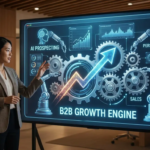
The New B2B Growth Engine: Connecting AI Prospecting, Personalization and Sales
October 13, 2026 at 6:21 pm

The marketing department of 2027 will not be defined by how many AI tools it owns. It will be defined by how intelligently it connects people, data, technology, and business objectives into one coordinated system. This is the fundamental difference between an AI-assisted marketing team and an AI-native marketing department.
Today, many businesses use AI to write blog posts, generate social media captions, summarize reports, or create advertising visuals. These applications can save time, but they often operate as isolated activities. One tool creates content, another manages email campaigns, and a separate platform tracks leads. The marketer is still responsible for manually connecting the pieces. The technology may be faster, but the underlying workflow remains fragmented.
An AI-native department approaches the problem differently. Instead of adding artificial intelligence to every existing task, it redesigns the process itself. Customer insights can inform content planning. Content performance can influence campaign decisions. Campaign engagement can inform lead qualification. Sales feedback can then improve targeting and messaging. Each activity contributes information that makes the next activity more effective.
This shift will change how businesses evaluate their marketing capabilities. The question will no longer be whether a company uses AI. The more important question will be whether its AI systems help the organization make better decisions, respond to customer needs, and generate measurable commercial outcomes.
For businesses exploring an AI Marketing Agency Singapore, this distinction matters. Implementing AI without a clear strategy can create more activity without producing meaningful growth. A well-designed approach starts with business objectives, identifies operational bottlenecks, and determines where AI can create the greatest value.
The AI-native marketing department is not a prediction that every marketer will be replaced by machines. It is a vision of a more connected, responsive, and intelligent organization. Human expertise remains essential, but routine execution increasingly becomes automated, allowing people to concentrate on strategy, creativity, relationships, and judgment.
The real competitive advantage will belong to businesses that stop treating AI as an add-on and start building their marketing operations around what it makes possible.
The New Marketing Team Structure: Humans, AI Agents, and Specialists
The traditional marketing department is organized around functions. Content teams create articles, SEO specialists improve search visibility, performance marketers manage campaigns, and sales development teams pursue qualified prospects. Each function has its own responsibilities, tools, and performance targets.
That structure will not disappear overnight, but AI-native marketing will encourage businesses to organize more work around connected outcomes rather than isolated tasks.
Imagine a company preparing to launch a new service. In a conventional department, the research, messaging, content creation, advertising, and lead qualification processes might involve several handoffs. Each team waits for information from the previous one, and valuable insights can become diluted along the way. In an AI-native department, coordinated workflows could help research customer needs, prepare campaign briefs, generate content variations, analyze early engagement, and recommend adjustments within a shared process.
AI agents may increasingly handle defined, multistep responsibilities. One system could support market research, another could help prepare campaign assets, and another could monitor performance against agreed objectives. However, these systems require clear permissions, reliable information, and human oversight. They should not be treated as independent employees capable of making every decision correctly.
Human marketers will remain central to the department. They will establish positioning, determine what the brand should stand for, challenge questionable insights, approve sensitive communications, and decide which opportunities deserve investment. These responsibilities require context, accountability, and judgment that cannot be reduced to task automation alone.
Businesses working with an AI Marketing Agency Singapore should therefore evaluate more than the provider’s list of tools. They should consider how strategy, technology, creative expertise, and campaign execution work together to achieve business goals.
The most valuable employees may become those who can translate business problems into effective AI-enabled workflows. They will understand customer behavior, evaluate outputs critically, and know when human intervention is necessary.
The future marketing department will not simply have fewer people doing the same work. It may have different responsibilities, different collaboration patterns, and different definitions of productivity.
The goal is not to remove the human element from marketing. It is to remove unnecessary friction so that human expertise has greater impact.
AI-Powered Workflows Will Replace Disconnected Marketing Tasks
A marketing department can invest in sophisticated technology and still operate inefficiently. The problem often lies not in the tools themselves, but in the gaps between them.
Consider the journey from customer research to revenue. A team identifies a market opportunity, creates a campaign, publishes content, attracts website visitors, captures leads, and passes prospects to sales. If these activities operate independently, important information gets lost. Content teams may not know which topics generate qualified enquiries. Advertising teams may optimize for clicks rather than business opportunities. Sales teams may receive leads without understanding the prospect’s interests or previous interactions.
AI-native marketing aims to connect these activities through integrated workflows.
A customer insight could trigger a content brief. The brief could inform a coordinated set of blog articles, LinkedIn posts, emails, and video assets. Performance data could reveal which messages attract the most relevant audience. Those signals could then inform campaign adjustments and lead qualification. When sales teams report that certain enquiries convert more effectively, the information can feed back into future targeting decisions.
This creates a more continuous operating model. Rather than treating every campaign as a separate project, the department learns from the results of previous activities and applies those lessons to subsequent decisions.
For an AI Marketing Agency Singapore supporting businesses across Singapore and Asia, the opportunity is to connect marketing processes with the commercial realities of different markets. Language preferences, industry requirements, buying behavior, and regional differences must remain part of the decision-making process.
However, workflow automation should not be confused with complete autonomy. Some activities can be automated safely, while others require approval. A routine internal report may need little intervention, whereas a public campaign, pricing communication, or customer data decision may require strict review.
Businesses should begin by identifying repetitive work, unnecessary handoffs, and delays that weaken campaign performance. They can then automate selected steps, connect relevant systems, and establish checkpoints for accuracy and accountability.
The most useful metric is not the number of automated tasks. It is the improvement in speed, quality, consistency, and commercial performance.
When workflows are designed properly, AI becomes more than a productivity shortcut. It becomes part of the infrastructure that helps marketing operate as a coordinated business function.
Content, SEO, and Brand Communication Will Become More Adaptive
The future of marketing content will not be measured by how much a company publishes. It will be measured by how effectively that content reaches the right audience, answers meaningful questions, and supports business growth. In 2027, AI-native marketing departments will increasingly treat content as a connected ecosystem rather than a collection of individual blog posts, videos, advertisements, and social media updates.
Imagine developing one strong business insight and transforming it into an entire campaign. The original idea becomes a detailed blog article, a series of LinkedIn posts, short-form videos, email content, and supporting landing pages. Each format serves a different purpose, but every asset communicates the same strategic message. AI can help accelerate this process while allowing marketers to adapt the content for different audiences, industries, and stages of the buyer journey.
This is where AI content generation becomes particularly valuable. Instead of beginning every asset from scratch, teams can reuse approved research, brand guidelines, customer insights, and existing content. The result is a more consistent publishing operation with fewer repetitive production tasks.
Search visibility will also become more complex. Traditional search engine optimization will remain important, but businesses must also consider how AI-powered search experiences discover, interpret, and reference information. Clear explanations, credible sources, consistent brand information, and useful content can help improve discoverability across different search environments. However, no strategy can guarantee that an AI search engine will mention a particular business.
An experienced AI Marketing Agency Singapore can help businesses connect content creation, SEO, distribution, and performance measurement into one coordinated strategy.
Yet automation must not become an excuse for publishing generic material. AI-generated content still requires editorial judgment, fact-checking, originality, and a distinctive point of view. A brand that publishes hundreds of interchangeable articles may create more noise than authority.
The winning approach combines machine efficiency with human insight. AI handles more of the production process, while marketers protect the ideas, experiences, and perspectives that make the brand worth listening to.
In an increasingly crowded digital environment, consistency creates recognition, but meaningful insight creates trust.
From Lead Generation to Predictive Customer Intelligence
For many businesses, marketing success has traditionally been measured by the number of leads generated. More form submissions, more contact records, and more enquiries are often treated as signs of progress. But a large database does not automatically translate into revenue. If the leads are poorly matched, uninterested, or unlikely to purchase, the sales team simply inherits a bigger workload.
An AI-native marketing department will increasingly focus on understanding customer signals and identifying opportunities with greater precision.
Instead of relying exclusively on job titles, company size, and industry categories, businesses can combine these characteristics with relevant behavioral information. Website interactions, content engagement, previous enquiries, CRM history, and appropriate account-level signals can help marketers understand which prospects may deserve additional attention.
AI systems can analyze these signals, identify patterns, and help prioritize accounts for further engagement. For example, a B2B company targeting regional enterprises might use AI to identify organizations that fit its ideal customer profile, examine relevant business developments, and recommend which accounts deserve sales follow-up. The system could also help prepare personalized messaging based on verified company information and the prospect’s likely business challenges.
An AI Marketing Agency Singapore can support this transformation by connecting lead generation, marketing automation, CRM data, and sales feedback. The objective is to make the entire customer acquisition process more intelligent, rather than simply increasing the number of contacts entering the funnel.
However, predictive intelligence is not the same as knowing what a customer will do. Behavioral signals can be incomplete, outdated, or misleading. A person researching a product may be gathering information for a colleague rather than preparing to buy. AI-generated predictions should therefore guide decisions, not be treated as unquestionable facts.
Businesses must also respect privacy requirements, data permissions, and appropriate limits on customer profiling.
The real opportunity lies in using AI to help marketing and sales teams work from a shared understanding of customer needs. Marketing can focus on attracting relevant opportunities, while sales receives better context for meaningful conversations.
Ultimately, the objective is not to contact everyone more efficiently. It is to identify the right opportunities, understand their needs, and engage them at the appropriate moment.
The New Rules of Marketing Leadership, Measurement, and AI Governance
An AI-native marketing department needs more than advanced technology. It needs leadership capable of turning that technology into measurable business value without compromising customer trust, brand reputation, or operational accountability.
For years, marketing teams have relied on familiar performance indicators such as impressions, clicks, engagement rates, website traffic, and lead volume. These metrics remain useful, but they do not always explain whether marketing is contributing to sustainable business growth. An AI-enabled department must connect activity to outcomes more clearly.
Leaders should evaluate whether AI is reducing production bottlenecks, improving campaign efficiency, increasing the quality of qualified leads, shortening response times, or contributing to pipeline growth. They should also consider the total cost of implementation, including software, integration, training, maintenance, and human review.
This is particularly important when working with an AI Marketing Agency Singapore. Businesses should expect a clear explanation of the problem being solved, the workflow being improved, the results being measured, and the limitations that remain. Technology demonstrations are useful, but they are not substitutes for evidence of business value.
Governance is equally important. AI systems can generate inaccurate information, expose confidential data, produce inappropriate messaging, or take actions that conflict with company policies. If an automated system can publish content, update customer records, or initiate outreach, the business must establish clear permissions and approval requirements.
A practical governance framework should identify which tasks can be automated independently, which require human approval, and which must remain under direct human control. Teams should also maintain clear procedures for correcting errors, reviewing outputs, and responding to incidents.
Marketing leaders must invest in people as well as platforms. Employees need the skills to assess AI outputs, interpret data, manage workflows, and recognize when automated recommendations are unreliable.
The strongest marketing leaders will not simply encourage everyone to adopt AI. They will build an environment where experimentation is purposeful, accountability is clear, and results are measured honestly.
AI creates new capabilities, but leadership determines whether those capabilities become a genuine advantage or an expensive source of complexity.
Conclusion
Businesses do not need to rebuild their entire marketing department overnight to prepare for 2027. The more practical approach is to start with existing business problems, identify where AI can make a measurable difference, and expand successful workflows gradually.
The first step is an honest assessment of current operations. Which activities consume excessive time? Where do teams repeatedly perform the same work? Which systems operate independently? Where are potential customers being overlooked because information is scattered across platforms? These questions reveal opportunities that may be more valuable than purchasing another AI subscription.
Next, businesses should prioritize a small number of workflows with clear objectives. Content repurposing, campaign reporting, customer segmentation, lead research, and initial lead qualification may offer useful starting points, depending on the organization’s needs and data readiness. Each initiative should have a defined owner, a baseline measurement, and a practical method for evaluating results.
The third step is building a reliable foundation. AI systems need accurate information, clear brand guidelines, appropriate access permissions, and connections to the platforms they are expected to support. Without these foundations, automation can accelerate existing mistakes instead of improving performance.
An AI Marketing Agency Singapore can help businesses evaluate their current marketing operations, select suitable use cases, and connect AI capabilities with their broader commercial strategy. The priority should be to solve meaningful problems rather than automate every available task.
Businesses should also train their teams to work effectively with AI. Employees need to understand how to provide context, evaluate outputs, supervise automated workflows, and make decisions when the system encounters uncertainty. Human oversight should evolve alongside the level of autonomy granted to AI.
Finally, successful experiments must be measured before they are expanded. A workflow that saves production time but lowers content quality may not represent progress. An automated lead-generation process that increases contact volume without improving qualification may simply create additional work for sales.
The future of marketing belongs to organizations willing to rethink how work gets done. Start with strategy, connect the right systems, establish responsible boundaries, and expand based on evidence.
An AI-native marketing department is not built by adopting everything at once. It is built by making deliberate improvements that compound over time.
The businesses that prepare now will be better positioned to enter 2027 with a marketing operation that is more connected, adaptable, and focused on growth.
