

How AI Search Decides Which Businesses to Mention—and Which Ones to Ignore
October 1, 2026 at 10:10 pm
How AI Can Turn One B2B Idea Into an Entire Content Ecosystem
October 2, 2026 at 5:31 pm

The AI marketing landscape has changed dramatically. Businesses can now access tools that generate content, analyze customer data, create advertisements, automate emails, identify prospects, optimize campaigns and even support increasingly autonomous workflows. The technology is no longer difficult to find. The harder question is knowing what to do with it.
This is where many businesses get stuck.
A company can subscribe to five, ten or even twenty AI platforms and still have a fragmented marketing operation. One tool creates content. Another analyzes data. Another manages social media. Another handles email. Another produces videos. But if these tools are operating independently, the business may simply be producing more activity rather than creating more growth.
That distinction matters.
An effective AI Marketing Agency Singapore approach begins with business objectives rather than software. Instead of asking, “Which AI tool should we buy?” the better question is, “What marketing problem are we trying to solve?”
Perhaps the business has plenty of website traffic but poor conversion rates. Perhaps the sales team is receiving too many unqualified leads. Perhaps content production is slow. Perhaps customer data exists across several disconnected systems. Perhaps marketing campaigns are being launched without enough intelligence behind them.
Each problem requires a different strategic response.
Recent research from McKinsey highlights the same issue from a broader perspective: many organizations are experimenting with AI, but relatively few have fundamentally redesigned their teams and workflows around it.
The lesson is simple.
AI tools provide capabilities. Strategy determines where those capabilities are applied.
The businesses that understand this distinction will stop treating AI as another collection of software subscriptions. They will start treating it as part of the architecture of their marketing operation.
That is where the real transformation begins.
The Real Competitive Advantage Is How AI Is Used
The most interesting thing about AI marketing is that access to the technology is becoming increasingly democratized.
Your competitor can use the same generative AI platform. Your agency can use it. A startup with five employees can use it. A multinational corporation can use it.
So where does differentiation come from?
Increasingly, it comes from how the technology is used.
Two businesses can have access to identical AI capabilities and produce completely different results because their strategies, data, workflows, positioning and customer understanding are different.
An AI Marketing Agency Singapore can help businesses think about AI from this broader perspective. The objective is not simply to introduce more automation. It is to identify where intelligence can improve the decisions that influence customer acquisition and revenue.
For example, AI could help a company analyze customer behavior before developing its content strategy. The resulting insights could influence audience segmentation. Those segments could then inform personalized messaging. That messaging could feed into campaign creation. Campaign performance could generate new data, which then improves the next campaign.
That is a system.
A standalone AI writing tool, by comparison, may simply produce another article.
The difference is strategic integration.
Research published in Business Horizons in 2026 similarly argues that AI’s performance impact varies depending on how well AI applications align with a company’s broader competitive strategy.
This changes the way businesses should evaluate AI.
The question is no longer simply whether an AI tool has impressive features. Businesses need to consider whether the tool fits their objectives, customer journey, data environment, workflows and measurement framework.
Technology can accelerate a bad process just as easily as a good one.
If the underlying marketing strategy is weak, adding AI may simply make weak marketing faster.
The smarter approach is to establish the strategy first and then use AI to strengthen it.
AI Marketing Strategy Connects Data, Content, Customers and Revenue
Marketing has traditionally been divided into departments, channels and activities.
SEO operates separately from content. Content operates separately from advertising. Advertising operates separately from sales. Analytics reports on what happened after the fact.
AI creates an opportunity to connect these pieces.
But connection does not happen automatically.
An AI Marketing Agency Singapore can help businesses approach AI as an interconnected marketing system rather than a collection of isolated applications.
Imagine a B2B company trying to generate more qualified opportunities.
AI can analyze market signals and identify potential accounts. It can help research those accounts and identify relevant business challenges. Content can then be developed around those challenges. Lead-generation campaigns can use those insights to create more relevant messaging. Engagement data can feed into lead scoring. Sales teams can receive richer information about prospect behavior. The results can then be analyzed to improve future campaigns.
Every stage produces intelligence for the next.
That is considerably more powerful than simply using AI to generate more blog posts.
The same principle applies to customer personalization. AI becomes more valuable when it can work with relevant first-party data, customer behavior and business context rather than operating from generic prompts.
This is why data architecture matters.
Without reliable data, AI may generate fast answers based on incomplete or disconnected information. With better data and clearer context, AI can support more meaningful analysis and decision-making.
HubSpot’s 2026 research similarly emphasizes the importance of connecting AI capabilities with data and business context, while McKinsey identifies insights, personalization and orchestration as important components of the evolving AI-enabled marketing model.
The goal, therefore, is not simply to create more marketing output.
It is to create a feedback loop.
Data informs decisions. Decisions shape campaigns. Campaigns create customer interactions. Customer interactions generate new data.
AI can help accelerate that entire cycle.
Strategy is what keeps the cycle pointed toward business growth.
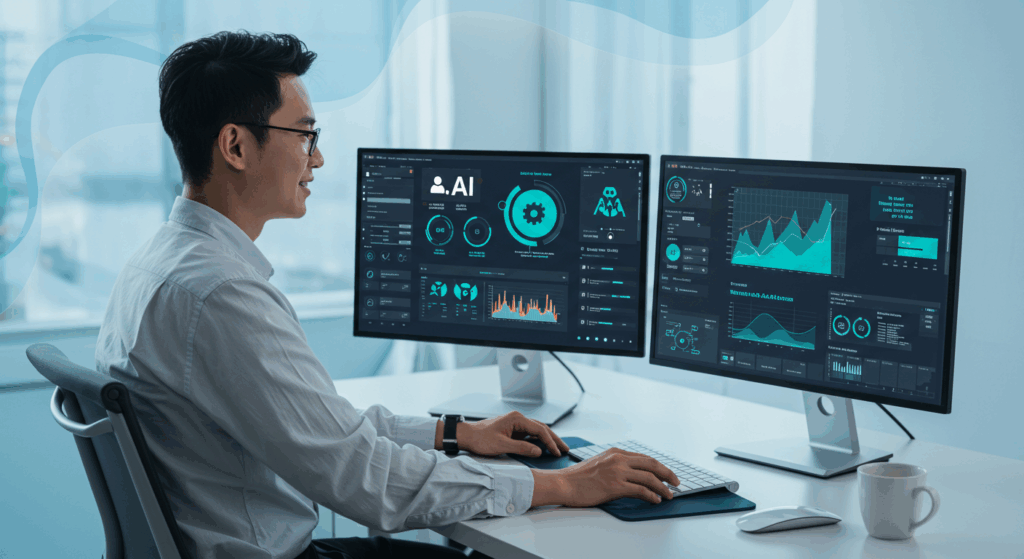
From AI Automation to Intelligent Marketing Systems
Automation is one of the easiest ways to understand AI.
Write this email.
Summarize this report.
Create this social post.
Generate five ad variations.
These applications can save time. They can also improve productivity when implemented properly.
But there is a much bigger opportunity.
AI can move marketing from isolated automation toward intelligent systems that continuously analyze information, make recommendations and support actions across multiple stages of the customer journey.
This is where an AI Marketing Agency Singapore can play a strategic role: helping businesses determine which processes should be automated, which should remain human-led and where AI should provide intelligence rather than simply execute tasks.
Consider campaign optimization.
A basic automation might send an email at a predetermined time.
A more intelligent system could analyze engagement, customer behavior and campaign performance, identify patterns and recommend adjustments to audience targeting or messaging.
The distinction is important.
Automation follows predefined instructions.
An intelligent marketing system can use data and context to support ongoing decisions.
This does not mean removing humans from the process. In fact, human oversight becomes even more important as AI systems become more capable.
Brand positioning, strategic judgment, ethical decisions and creative direction still require human involvement. AI can process enormous amounts of information, but businesses remain responsible for deciding what they stand for and how they communicate it.
BCG’s 2026 research into agentic marketing describes a similar transition, highlighting the importance of data foundations, brand intelligence and redesigned operating models as companies move toward more advanced AI workflows.
The future is therefore not simply “more automation.”
It is better coordination between humans, data, AI and marketing processes.
That requires architecture.
And architecture requires strategy.
AI Search Is Changing What Marketing Strategy Needs to Consider
For years, businesses built digital marketing strategies around search engines.
The formula was familiar.
Research keywords. Create content. Build authority. Optimize pages. Earn rankings. Generate traffic.
That world is still important, but the customer journey is changing.
AI-powered search and answer systems are increasingly influencing how people discover information, compare options and research businesses. That means marketers need to think beyond simply ranking a webpage.
They also need to consider whether their brand is understandable, relevant and credible enough to appear within AI-generated answers and recommendations.
This creates another strategic reason to work with an AI Marketing Agency Singapore that understands the relationship between traditional SEO, content strategy, brand authority and emerging AI search behavior.
A business cannot simply publish hundreds of generic articles and expect AI systems to consistently recommend it.
Content needs substance.
It needs clear expertise. It needs useful information. It needs context. It needs consistency across the company’s digital presence.
The strategy also needs to consider the questions customers are actually asking.
A potential buyer may not search for a product using one perfect keyword. They may ask a series of increasingly specific questions about pricing, implementation, alternatives, risks, integrations and business outcomes.
That means marketing content needs to support the entire decision process.
McKinsey’s 2026 analysis describes AI as reshaping customer discovery and marketing around capabilities such as insights, personalization, agentic commerce and orchestration.
This represents a broader shift.
Search is becoming less about one query and one webpage.
Marketing is increasingly about becoming a useful source of information across an entire customer journey.
Businesses that understand this early can build content and brand systems designed for both traditional search and emerging AI-mediated discovery.
Again, the technology matters.
But the strategy determines how the technology is used.

Building an AI Marketing Strategy That Actually Supports Business Goals
An AI marketing strategy should not begin with a shopping list of software.
It should begin with the business.
What are the company’s biggest growth constraints?
Where are marketing teams losing time?
Where are customers dropping out of the funnel?
Which activities generate meaningful revenue?
Where is data being underused?
Where could better intelligence improve decision-making?
These questions create the foundation for an AI Marketing Agency Singapore to design a strategy around actual business needs rather than AI hype.
The next step is prioritization.
Not every marketing process needs AI. Some processes may be better handled by people. Others may benefit from simple automation. Some may require advanced AI capabilities or agentic workflows.
The objective is to match the technology to the problem.
Measurement is equally important.
Businesses should define what success means before deploying an AI system. Depending on the use case, that could include lead quality, conversion rates, customer acquisition cost, campaign performance, content engagement, sales productivity or revenue contribution.
This is where many AI initiatives fall apart.
Teams measure how much content was produced or how many hours were saved, but those numbers do not necessarily prove business value.
Gartner has emphasized this distinction, arguing that marketing leaders need to move beyond efficiency measurements toward measurable business outcomes.
A practical AI strategy should therefore include four elements: clear objectives, carefully selected use cases, connected workflows and measurable KPIs.
Then comes continuous improvement.
AI marketing should not be treated as a one-time implementation. Models change. Customer behavior changes. Search behavior changes. Competitors change. New AI capabilities emerge.
The strategy must evolve with them.
The goal is not to build a perfect AI system once.
The goal is to build a marketing system capable of learning and improving continuously.
Conclusion
The AI conversation is moving beyond experimentation.
For many businesses, the question is no longer whether AI belongs in marketing. The more important question is how deeply AI should be integrated into the marketing operating model.
That is why an AI Marketing Agency Singapore increasingly needs to think beyond individual tools and campaigns.
The next stage is systems thinking.
AI can sit across research, content, SEO, advertising, lead generation, customer segmentation, personalization, analytics and sales enablement. Each capability becomes more valuable when it can exchange information with the others.
That creates something different from a collection of AI tools.
It creates an AI-powered marketing system.
The distinction will become increasingly important as AI capabilities become more accessible. When everyone can generate content, create images, analyze data and automate basic workflows, those capabilities become less distinctive on their own.
The strategic layer becomes more important.
Who are you targeting?
What problem are you solving?
What signals indicate buying intent?
Which channels matter?
What information should customers receive at each stage?
What should AI automate?
What requires human judgment?
How will success be measured?
These are strategic questions, not software questions.
Recent research from BCG similarly points toward operating infrastructure, data foundations and redesigned marketing models as important factors in moving AI from experimentation into broader transformation.
The lesson for businesses is straightforward.
Do not chase every new AI tool.
Build the strategy first.
Then select the technology that supports it.
AI will continue to evolve at extraordinary speed. New platforms will appear. Existing platforms will become more capable. Entire categories of marketing software may change.
But the fundamental need for strategy will remain.
The businesses that create durable value from AI will not necessarily be those with the largest collection of tools.
They will be the ones that understand their customers, connect their data, redesign their workflows and use AI deliberately to move the business toward measurable objectives.
The tool is only the instrument.
The strategy is what gives it direction.
