
How AI Can Improve Sales Conversion Rates Without Hiring More Staff
August 28, 2026 at 5:45 pm
AI Sales Intelligence Is Becoming Every Sales Director’s Competitive Weapon
August 31, 2026 at 8:13 pm
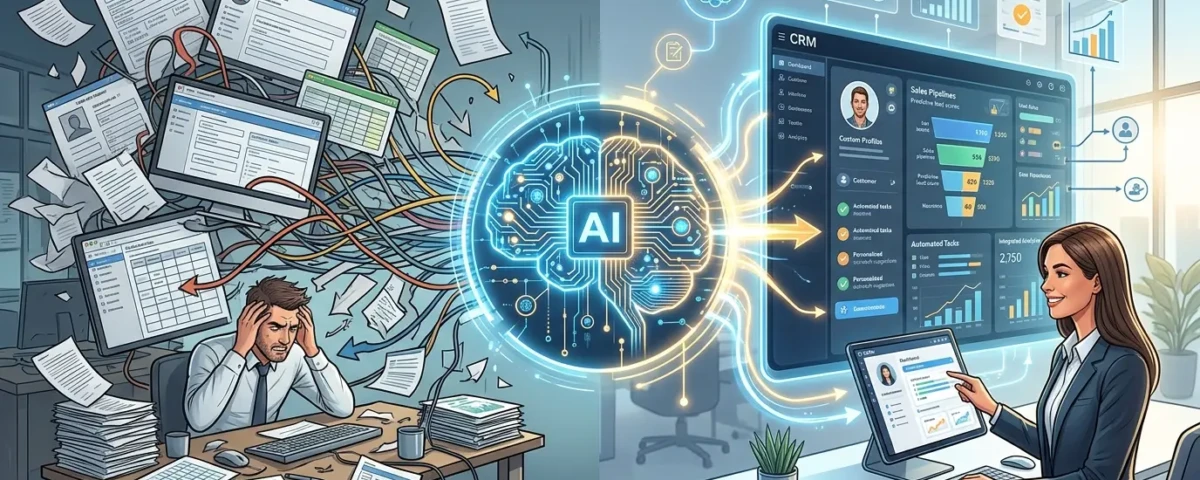
For years, companies have invested heavily in CRM systems with the promise of creating a single source of truth for their customers. Yet many sales teams still treat CRM as an administrative obligation rather than a competitive advantage. Reps enter notes after meetings, update opportunity stages, log activities, and maintain contact records—often because management requires it, not because the system actively helps them sell.
That is the fundamental weakness of traditional CRM.
A database can tell you what happened. It does not necessarily tell you what matters, what is changing, or what should happen next.
AI changes that equation. Modern AI-powered CRM systems can analyze customer interactions, identify patterns, surface relevant information, and recommend actions. Instead of simply storing customer records, AI can turn those records into usable intelligence.
This is where an AI Marketing Agency Singapore can play a strategic role. The value of AI is not simply adding another tool to the marketing stack. It is about connecting customer data, marketing activity, sales behavior, and buyer intent so teams can make better decisions.
The shift is important because businesses no longer have the luxury of wasting sales capacity on administrative work. In Singapore, Salesforce reported in 2026 that 80% of surveyed sales organizations were already using some form of AI for activities such as prospecting, forecasting, lead scoring, or email drafting.
The CRM of the future will not ask salespeople to work harder to maintain the database.
It will work harder for them.
That is the real promise of AI.
Stop Collecting Data. Start Understanding What It Means.
Most companies do not have a shortage of customer data. They have a shortage of useful insight.
A CRM might contain thousands of contacts, years of sales activity, email conversations, meeting notes, opportunity records, purchase histories, and marketing interactions. The problem is that humans cannot realistically analyze every signal across every account every day.
AI can.
An intelligent CRM can examine patterns across customer behavior and identify signals that might otherwise disappear inside a mountain of information. A prospect who repeatedly visits a pricing page, downloads technical material, responds quickly to emails, and suddenly increases engagement may be far more valuable than another contact who simply opened one newsletter.
Traditional CRM reporting may show those activities separately.
AI can connect the dots.
That is what makes AI particularly powerful for an AI Marketing Agency Singapore strategy. Instead of treating marketing engagement and sales activity as disconnected events, AI can help businesses build a clearer picture of buyer intent.
It can analyze behavioral patterns, customer history, engagement levels, and opportunity activity to generate recommendations around what may happen next. Modern AI CRM platforms increasingly offer predictive scoring, forecasting, data enrichment, and next-best-action recommendations.
This does not mean AI magically understands customers.
It means businesses finally have a practical way to process the enormous amount of information they already collect.
The difference is enormous.
A traditional CRM says, “Here is everything we know.”
An AI-powered CRM starts asking, “Here is what matters.”
And that is when customer data starts becoming commercially useful.
Your Salespeople Should Not Be Treating Every Lead Equally
One of the biggest problems in sales is not a lack of leads.
It is poor prioritization.
Give a salesperson 500 leads and you have not necessarily given them 500 opportunities. You have given them 500 decisions about where to spend their limited time.
Which prospect should receive a call first?
Which account deserves personalized outreach?
Which opportunity is genuinely active?
Which lead is quietly going cold?
Human judgment still matters, but asking salespeople to manually answer these questions across hundreds or thousands of records is inefficient.
AI can continuously evaluate signals and help rank opportunities based on likely buying intent. Instead of relying only on static lead-scoring rules, AI can examine behavioral patterns and compare current activity with historical outcomes.
That creates a major opportunity for an AI Marketing Agency Singapore working with B2B organizations.
The objective is not simply to generate more leads.
It is to help businesses identify which leads deserve attention now.
Imagine a CRM automatically telling a salesperson:
“This account has increased engagement significantly over the last 14 days. Three decision-makers have interacted with your content. The company has returned to the pricing page twice. Similar accounts historically converted after this pattern. Follow up now.”
That is dramatically different from a CRM showing a contact name, phone number, job title, and last activity date.
AI does not eliminate the salesperson.
It gives the salesperson better intelligence before making the call.
And in competitive markets, knowing who to call first can be worth far more than simply having a bigger database.
AI Could Warn You About a Dying Deal Before It Becomes a Lost Deal
Sales forecasts have always had one uncomfortable weakness: they often depend heavily on human judgment.
A salesperson says a deal is likely to close this quarter. A manager believes the opportunity looks healthy. The CRM shows the opportunity sitting in the pipeline.
Then the quarter ends.
The deal disappears.
Traditional CRM systems are good at recording the final outcome. They are far less effective at explaining the subtle warning signs that appeared weeks earlier.
AI changes that.
By analyzing historical sales cycles, engagement patterns, deal activity, communication frequency, opportunity age, and other signals, AI can identify patterns associated with stalled or at-risk opportunities. Modern AI CRM tools increasingly provide deal-level insights, close-probability analysis, and alerts for opportunities losing momentum.
This is where an AI Marketing Agency Singapore can help businesses move beyond simple pipeline reporting.
Instead of asking, “How much revenue is in our pipeline?” companies can start asking better questions.
Which opportunities are genuinely healthy?
Which ones are being artificially kept alive?
Which accounts have stopped engaging?
Which deals need executive intervention?
Which objections are appearing repeatedly?
AI can surface these patterns much earlier than traditional reporting.
That does not mean every prediction will be correct. AI is not a crystal ball, and businesses should never treat predictive scores as absolute truth.
But even imperfect early warning can be valuable.
The real advantage is not predicting the future perfectly.
It is discovering problems while there is still time to change the outcome.

Your Salespeople Should Sell—Not Spend Their Day Updating the CRM
There is a strange contradiction at the heart of traditional CRM.
Companies buy CRM software to make sales teams more productive.
Then salespeople spend valuable selling time maintaining the CRM.
After every meeting comes the administrative aftermath: write notes, update the opportunity, record next steps, create follow-up tasks, draft emails, change contact information, and remember what was discussed.
Do this across dozens of opportunities and the administrative burden becomes significant.
AI can finally attack that problem at its source.
Modern AI CRM capabilities can extract information from conversations, suggest CRM updates, create follow-up tasks, draft emails, and recommend next actions.
This is one of the strongest reasons businesses should work with an AI Marketing Agency Singapore when evaluating AI-driven revenue operations. The goal should not be automation for automation’s sake. The goal should be removing friction from the customer acquisition process.
Imagine finishing a sales meeting and having AI automatically prepare the meeting summary, identify the customer’s priorities, update relevant CRM fields, suggest the next action, and draft a personalized follow-up email.
The salesperson reviews it.
Approves it.
Moves on.
That is a very different experience from manually reconstructing the conversation 30 minutes later.
And there is another benefit: better data.
When CRM updates depend entirely on human memory and discipline, information will inevitably be incomplete.
When AI can capture and structure information directly from actual customer interactions, the CRM has a better chance of reflecting reality.
The result is simple:
Less administration.
Better data.
More selling.
That is what CRM software should have been doing all along.
Marketing and Sales Can Finally Stop Fighting Over Whose Data Is Right
Marketing believes it is generating qualified leads.
Sales believes marketing is sending junk.
Marketing points to campaign engagement.
Sales points to poor conversion.
Meanwhile, the CRM sits in the middle, containing fragments of information from both sides.
This is not primarily a technology problem.
It is an intelligence problem.
AI can help create a more unified understanding of the customer by analyzing signals across marketing, sales, service, website behavior, communications, and customer history. The broader CRM market is increasingly moving toward platforms that connect these functions around a shared customer record and increasingly embed AI into execution and decision-making.
For an AI Marketing Agency Singapore, this creates a much bigger strategic opportunity than simply automating marketing campaigns.
Imagine marketing can see that a target account is showing unusually strong buying intent.
Instead of sending another generic email campaign, marketing can alert sales.
Sales can then see the account’s engagement history, previous conversations, relevant content consumed, and potential decision-makers.
The salesperson enters the conversation with context.
That is the foundation of modern Account-Based Marketing.
AI can help businesses identify high-value accounts, understand engagement patterns, personalize messaging, and coordinate activity across the customer journey.
The result is not merely better marketing or better sales.
It is a more intelligent revenue engine.
When marketing and sales operate from the same customer intelligence, the argument changes from “Whose lead is this?” to “What should we do next?”
That is a much more productive conversation.
Conclusion
The biggest change AI brings to CRM is not another dashboard.
It is a change in the role of the system itself.
Traditional CRM has largely been a system of record. It stores contacts, opportunities, activities, notes, and customer information.
The emerging AI-powered CRM is becoming something closer to a system of intelligence and execution.
It can identify patterns.
It can prioritize opportunities.
It can flag risks.
It can recommend actions.
It can automate repetitive work.
It can help generate communications.
And increasingly, AI agents can operate directly inside CRM workflows, using real-time customer data and business rules to perform tasks rather than simply presenting information to employees.
This is why the next generation of CRM matters so much for an AI Marketing Agency Singapore. The competitive advantage will not come from simply owning a CRM with an AI button.
It will come from building an intelligent process around it.
Businesses still need clean data.
They still need clear sales processes.
They still need human judgment.
And they still need governance around what AI can and cannot do.
AI cannot rescue a completely broken revenue process by itself.
But when the foundations are sound, AI can turn the CRM from a passive database into an active sales partner.
That is the real opportunity.
The question is no longer whether your CRM can store enough customer information.
The better question is whether it can help your team understand that information and act on it.
Because the CRM of the future should not simply tell your salesperson what happened yesterday.
It should help them decide what to do today.
And, ideally, it should do some of the work itself.
That is when CRM finally becomes useful.
