

The New Role of Human Judgment in an AI-Powered Marketing Department
October 20, 2026 at 5:29 pm
How AI Can Help Marketing Teams Detect Customer Churn Before It Becomes Revenue Loss
October 21, 2026 at 6:12 pm

For many B2B companies, lead generation success is measured by a number that looks impressive on a marketing report: total leads generated. The campaign delivers hundreds of new contacts, website enquiries increase, and the marketing team celebrates. But when sales starts making calls, the reality can be very different. Prospects do not respond. Enquiries come from companies that cannot afford the service. Contacts lack decision-making authority. Others are simply researching without any intention of buying.
The pipeline looks busy, but revenue remains stubbornly flat.
This is the lead generation trap. Businesses become so focused on filling the funnel that they overlook whether the people entering it are worth pursuing. More leads can create more administrative work, more follow-up emails, more sales meetings with poor-fit prospects, and more pressure on a team that is already stretched. When these activities fail to produce meaningful opportunities, additional lead volume becomes a cost rather than a competitive advantage.
For companies investing in B2B Lead Generation for Singapore, this distinction matters. Singapore’s B2B market includes businesses with different budgets, buying cycles, decision-making structures, and growth priorities. A large database of contacts does not automatically translate into a pipeline of organisations that genuinely need a company’s services.
The smarter question is not how many leads marketing can generate. It is how many of those leads can become qualified opportunities and, eventually, paying customers.
This requires a fundamental change in how businesses define success. Instead of treating lead volume as the primary indicator of performance, organisations need to examine lead-to-opportunity conversion, sales acceptance, customer acquisition costs, and revenue contribution.
AI-assisted lead quality offers a way to make that shift. By analysing prospect characteristics, engagement patterns, and available buying signals, AI can help marketing and sales teams identify which leads deserve attention first. It does not eliminate uncertainty, but it can make prioritisation more systematic.
Ultimately, the objective is not to fill the funnel until it overflows. It is to build a pipeline that gives sales a realistic chance of closing business.
The Hidden Cost of Poor Lead Quality: Where Marketing Budgets Go to Waste
Poor lead quality rarely appears as a single, obvious expense. Instead, it quietly drains resources across the entire revenue process. Marketing pays to attract prospects who are unlikely to convert. Sales representatives spend hours researching unsuitable companies. Automated campaigns continue nurturing contacts who will never become customers. Meanwhile, genuinely promising opportunities may receive less attention because they are buried beneath a growing volume of irrelevant enquiries.
The financial impact extends beyond the cost of acquiring a contact.
Consider a company that generates 500 leads in a month. At first glance, the campaign may appear successful. However, if only a small proportion meet the company’s ideal customer profile, the sales team must work through a large amount of wasted activity before finding viable opportunities. The business may need more salespeople, more outreach tools, and more follow-up sequences simply to compensate for weak qualification.
Now consider a smaller campaign that generates 150 leads, with a higher proportion coming from companies that have a relevant business problem, sufficient budget, and the authority to make a purchasing decision. Although the lead count is lower, the team may have a better opportunity to generate revenue.
The numbers will vary by industry and sales process, but the principle is consistent: lead volume alone cannot establish campaign profitability.
This is why B2B Lead Generation for Singapore should be evaluated against commercial outcomes rather than contact acquisition alone. Businesses need to understand the difference between a marketing-qualified lead (MQL), which meets agreed marketing criteria, and a sales-qualified lead (SQL), which has been assessed as suitable for direct sales engagement.
Neither label should be assigned casually. Qualification criteria must reflect actual business requirements, including company fit, potential need, buying authority, budget considerations, and timing.
AI can help identify patterns in historical lead and sales data, revealing which sources and prospect characteristics are associated with better outcomes. However, AI cannot compensate for inaccurate data or unclear qualification rules. If the underlying process rewards quantity rather than quality, automation may simply accelerate the waste.
The first step is to calculate what poor-quality leads actually cost the business. Once the waste becomes measurable, lead quality stops being a vague sales complaint and becomes a practical revenue management priority.
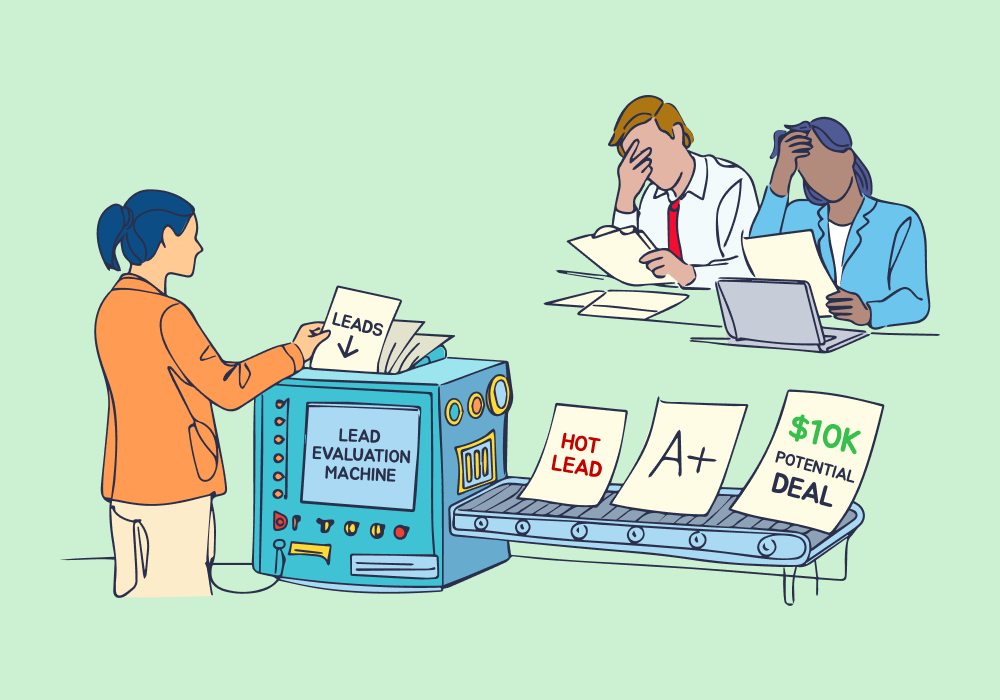
Beyond Traditional Lead Scoring: How AI Separates Potential Buyers From Busy Browsers
Traditional lead scoring attempts to solve the quality problem by assigning points to prospects according to predefined characteristics. A decision-maker might receive more points than a junior employee. A company within the target revenue range might score higher than a smaller organisation. A prospect who downloads a whitepaper or attends a webinar might receive additional points.
This approach provides structure, but it has a weakness: activity does not always equal buying intent.
A person can download five reports without having any intention of purchasing. A senior executive can visit a website out of curiosity. A prospect can open every marketing email yet lack the budget or authority to move forward. When scoring systems reward engagement without considering context, they can produce misleading results.
AI-assisted lead scoring can provide a more nuanced approach by evaluating multiple signals together. These may include company characteristics, job responsibilities, previous interactions, enquiry details, historical conversion patterns, and the recency of a prospect’s activity. Where reliable data is available, machine learning models can identify combinations of characteristics that have historically been associated with successful sales outcomes.
For businesses pursuing B2B Lead Generation for Singapore, this can help distinguish between prospects who simply engage with content and those who appear to fit the business’s target market and demonstrate meaningful interest.
Imagine two contacts from the same industry. The first downloads an introductory guide but works for a company outside the service provider’s target market. The second visits a service page several times, requests information about implementation, and works for an organisation that closely matches the ideal customer profile. An AI-assisted system can help prioritise the second contact, provided the available signals are reliable and appropriately interpreted.
The objective is not to create an impressive-looking score. It is to improve the quality of decisions made by marketing and sales.
Businesses should begin with transparent qualification rules and introduce predictive models when they have sufficient reliable historical data. Scores should be tested against actual sales outcomes, reviewed regularly, and explained in terms that sales representatives can understand.
AI should inform human judgement, not replace it. A high score is a reason to investigate a prospect more closely, not proof that the prospect will buy.
From Contact Data to Buyer Intent: Why Timing Matters as Much as Fit
Knowing who a prospect is represents only half of the qualification challenge. Understanding whether that prospect has a relevant business need and is considering a solution is equally important.
A company may fit every requirement on paper. It operates in the right industry, employs the right number of people, and has sufficient resources to afford the service. Yet its leadership team may have no immediate plans to purchase. Another company with a similar profile may be actively evaluating providers because an existing solution is underperforming or a new growth initiative requires urgent support.
Treating these two companies identically wastes valuable sales capacity.
Effective B2B Lead Generation for Singapore should therefore consider both prospect fit and buying intent. Fit helps answer whether an organisation is suitable to serve. Intent helps assess whether there are credible indications that it may be moving towards a purchasing decision.
AI can help analyse available behavioural and engagement signals, such as repeated visits to relevant service pages, requests for consultations, interactions with product comparisons, and engagement with content addressing specific business problems. When combined with company information and previous sales outcomes, these signals may help teams identify prospects who warrant timely follow-up.
However, intent must be interpreted carefully. A pricing-page visit does not automatically mean a purchase is imminent. Several people from one organisation may be conducting research, and some interactions may not represent genuine buying activity. AI-generated predictions are only as dependable as the data, assumptions, and validation behind them.
The practical advantage comes from recognising patterns rather than reacting blindly to individual actions.
For example, a prospect who repeatedly explores information about a particular service and then submits a detailed enquiry may deserve faster attention than someone who has only interacted with introductory content. Meanwhile, a suitable prospect showing limited immediate intent may benefit from educational emails and periodic follow-up instead of aggressive sales outreach.
This creates a more intelligent approach to prioritisation. High-fit, high-intent prospects can be directed towards sales conversations. High-fit prospects with limited intent can enter relevant nurturing programmes. Poor-fit contacts can be filtered out or redirected appropriately.
AI-assisted lead quality is not about pressuring every prospect to buy sooner. It is about recognising when a sales conversation is relevant, when further education is needed, and when resources are better spent elsewhere.
Connect the Dots: Why AI Lead Quality Depends on CRM and Sales Integration
Even a sophisticated AI scoring system can fail when the underlying business processes are disconnected. Marketing may know which campaign generated a lead, the CRM may contain basic contact details, and sales may have valuable information from conversations. If these systems do not share useful information, the business never develops a complete picture of its prospects.
The result is fragmented intelligence.
Marketing may continue targeting an account that sales has already disqualified. A prospect may receive introductory emails after requesting a consultation. A sales representative may overlook a promising contact because the CRM does not reflect recent engagement. Over time, inconsistent records and unclear ownership undermine the effectiveness of lead qualification.
For organisations investing in B2B Lead Generation for Singapore, CRM integration provides the operational foundation for turning lead intelligence into action.
A connected process can bring together information such as original lead source, company profile, campaign engagement, enquiry history, qualification status, and sales outcomes. AI-assisted workflows can then help update lead priorities, notify sales representatives when relevant signals appear, assign leads according to agreed rules, and place less-ready prospects into appropriate nurturing sequences.
The important distinction is that collecting data is not the same as using it effectively. The system must translate information into a clear next step.
Consider a prospect who initially downloads a guide, later returns to a relevant service page, and eventually submits an enquiry describing a specific business challenge. If the CRM captures these interactions appropriately, the sales team can approach the prospect with greater context. The conversation can begin with the business problem rather than a generic introduction.
Sales feedback is equally important. When a representative marks a lead as unsuitable, the reason should be recorded consistently. Perhaps the company is too small, the contact lacks authority, the timing is wrong, or the prospect has a requirement the business cannot support. These outcomes help the team assess whether its qualification criteria need adjustment.
Data quality must remain a priority. Duplicate contacts, missing fields, outdated company details, and inconsistent sales stages can distort scores and weaken automation. Access controls, privacy safeguards, and appropriate consent practices must also be maintained.
AI should support a clearly defined process, not conceal a broken one. Before introducing complex predictive models, businesses should establish clean CRM records, shared qualification definitions, reliable lead routing, and a feedback loop between marketing and sales.
When those fundamentals are in place, B2B Lead Generation for Singapore becomes easier to manage as a connected revenue process rather than a collection of disconnected campaigns and tools.
Stop Counting Leads and Start Measuring Revenue: The Metrics That Matter
A marketing dashboard can look impressive while the business struggles to grow. Lead counts rise, email engagement improves, and campaign costs appear manageable. Yet if qualified opportunities and closed deals remain unchanged, those numbers tell only part of the story.
Businesses need to measure what happens after a lead enters the funnel.
For companies pursuing B2B Lead Generation for Singapore, the goal should be to connect marketing activity with sales performance and revenue outcomes. This means moving beyond raw volume and examining whether campaigns attract prospects who progress through the buying journey.
Several metrics deserve closer attention.
First, measure the lead-to-opportunity conversion rate. This reveals how effectively generated leads become genuine sales opportunities. A campaign generating fewer leads but a higher proportion of qualified opportunities may be more valuable than one delivering a much larger volume of unqualified contacts.
Second, monitor the opportunity-to-customer conversion rate. This helps establish whether the opportunities entering the pipeline are realistic prospects for the business. If many opportunities fail to close, the organisation may need to examine its qualification process, pricing, sales execution, or target audience.
Third, calculate customer acquisition cost (CAC) and revenue generated per lead. These measures help businesses evaluate whether their marketing investments are producing commercially meaningful results. Where possible, examine gross profit and customer lifetime value as well, rather than relying solely on initial contract value.
AI-assisted analysis can help identify patterns across these metrics. Businesses may discover that certain campaigns generate more qualified opportunities, that particular industries have shorter sales cycles, or that some prospect characteristics are associated with stronger conversion rates. These insights can inform future targeting and budget allocation.
However, measurement requires discipline. Attribution models can be imperfect, sales cycles can span several months, and different channels may influence the same purchase. Businesses should compare equivalent reporting periods and account for the time required for leads to mature.
A practical starting point is to establish baseline performance before introducing AI, then monitor changes in qualification rates, sales acceptance, conversion, acquisition costs, and revenue.
The objective of B2B Lead Generation for Singapore is not simply to make marketing look productive. It is to understand which activities create the strongest commercial opportunities and direct resources accordingly.
When marketing performance is measured against revenue rather than vanity metrics, decision-making becomes more grounded. Budgets can be allocated with greater confidence, sales teams gain clearer priorities, and leadership can evaluate growth investments using evidence rather than assumptions.
Conclusion
The future of lead generation will not be defined by how many contacts a company can add to its database. It will be defined by how effectively the business identifies relevant opportunities, understands buyer needs, and turns that knowledge into revenue.
Generating more leads will always have a place in growth strategy. Businesses need sufficient reach to discover new customers and expand into new markets. But volume without qualification creates a fragile growth model. It can overwhelm sales teams, obscure campaign performance, and increase acquisition costs without delivering proportional returns.
AI-assisted lead quality offers a more disciplined path forward. By combining company fit, engagement patterns, available intent signals, and historical conversion outcomes, businesses can develop a clearer understanding of which prospects deserve immediate attention and which require further nurturing.
For companies investing in B2B Lead Generation for Singapore, the first step does not have to be an expensive predictive AI platform. Start by examining the existing funnel. Identify where leads are being disqualified, which sources produce genuine opportunities, and why prospects fail to progress. Establish shared qualification criteria between marketing and sales, improve CRM data quality, and measure baseline conversion performance.
Once these foundations are established, AI can help identify patterns, prioritise follow-up, and improve the consistency of lead management. The system should be reviewed regularly against actual sales outcomes, with human oversight ensuring that recommendations remain commercially sensible.
It is also important to recognise what AI cannot guarantee. No model can eliminate uncertainty from B2B buying decisions. Budgets change, priorities shift, and qualified prospects may still choose a competitor or postpone purchasing. The purpose of AI is to improve decisions under uncertainty, not to promise perfect predictions.
Businesses should also maintain responsible data practices, protect prospect information, and ensure that automated decisions can be reviewed when necessary.
Ultimately, sustainable growth requires more than a bigger funnel. It requires a stronger connection between marketing investment, sales execution, and customer value.
The most effective B2B Lead Generation for Singapore strategy is one that helps a business spend less time chasing unsuitable contacts and more time developing meaningful opportunities.
More leads may create the appearance of progress. Better-qualified leads create the conditions for real progress.
The next competitive advantage belongs to businesses that understand the difference—and build their lead generation systems around it.
