
The Future of B2B Lead Qualification: AI Looks Beyond Job Titles and Company Size
October 7, 2026 at 7:01 pm
The AI Search Visibility Gap: Why Some Brands Get Mentioned While Others Stay Invisible
October 8, 2026 at 5:15 pm
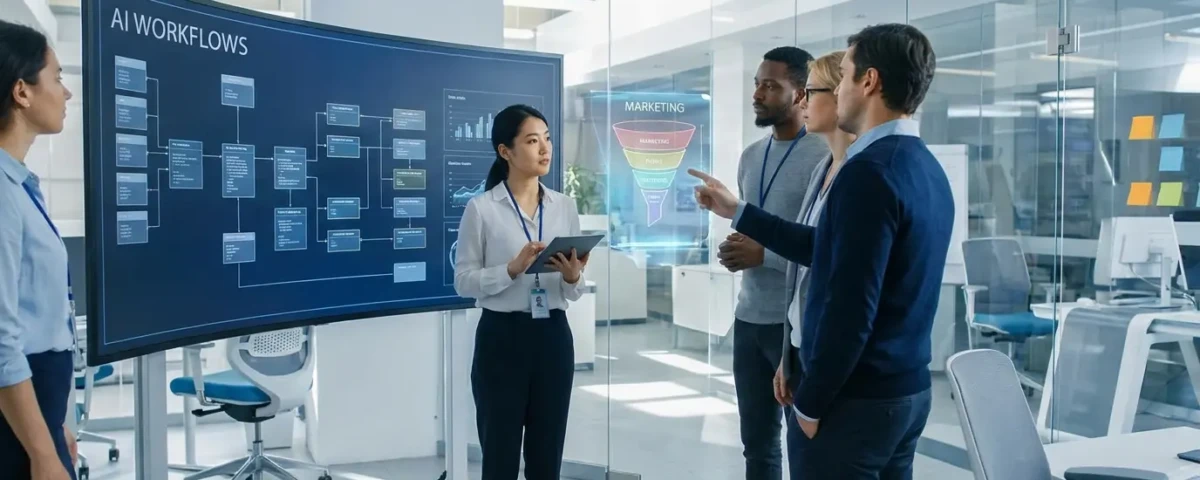
For years, marketing teams have been built around a familiar formula: hire specialists, give them software, create processes, hold meetings, and hope everything eventually comes together. A content team produces articles. The SEO team researches keywords. The social media team creates posts. The lead generation team finds prospects. Sales follows up. Analytics arrives later to explain what happened.
The problem is not that these teams are incapable. The problem is that they often operate in separate lanes.
Modern marketing has become too complex for disconnected teams and isolated software to keep up. Customer behaviour moves quickly. Search is changing. Content formats are multiplying. Buyers interact with brands across more channels before they ever speak to a salesperson. Meanwhile, marketing teams are expected to produce more content, generate more leads, personalise more experiences, and prove stronger ROI.
This is where AI workflows begin to change the equation.
The next generation of marketing teams will not simply ask which AI tools they should buy. They will ask how those tools, data sources, people, and decisions can work together as one system. That is a fundamentally different question.
An effective AI Marketing Agency Singapore approach is therefore not simply about adding artificial intelligence to existing marketing activities. It is about redesigning how marketing work moves from one stage to another.
AI can analyse information, identify patterns, generate content, automate repetitive processes, support personalisation, and surface opportunities. But its greatest value emerges when these capabilities are connected.
The competitive advantage will not belong to the company with the longest list of AI subscriptions. It will belong to the company that builds a marketing machine where information flows intelligently, repetitive work is reduced, and human marketers spend more time making decisions that actually matter.
The old model was people using tools.
The emerging model is people orchestrating intelligent workflows.
AI Workflows Turn Marketing From a Collection of Tasks Into a System
Using AI for marketing is easy.
Building an AI-powered marketing workflow is much harder.
There is a major difference between asking an AI tool to write a social media post and building a system that identifies an audience need, researches the topic, develops the content, adapts it for multiple channels, monitors engagement, analyses the response, and feeds those insights back into the next campaign.
The first example automates a task.
The second creates a system.
This distinction will become increasingly important as businesses adopt AI. An AI Marketing Agency Singapore strategy should not be measured by how many individual tasks AI can perform. It should be measured by how effectively AI connects the different stages of marketing execution.
Imagine a potential customer searching for a problem your business solves. That search behaviour could inform content development. The content could attract visitors. Website behaviour could provide additional signals. Those signals could influence segmentation. Segmentation could trigger personalised communication. Engagement could then influence lead scoring. Sales could receive better context before contacting the prospect.
That is a workflow.
The power comes from the connections between the steps.
This also changes how marketers should think about automation. Automation is not simply about making a process faster. It is about making the process smarter, more responsive, and less dependent on manual intervention.
An AI Marketing Agency Singapore model can help businesses think beyond isolated AI applications and towards connected marketing operations.
The goal is not to remove humans from the system.
The goal is to remove unnecessary friction from the system.
When repetitive research, formatting, segmentation, reporting, and production tasks are handled intelligently, marketers can spend more time on positioning, creative direction, customer understanding, strategic decisions, and growth.
That is where AI workflows become more than another technology trend.
They become a new operating model for marketing.

The Marketer’s Role Is Shifting From Execution to Orchestration
Marketing has traditionally rewarded people who can execute.
Write the campaign. Build the landing page. Create the email. Schedule the post. Pull the report. Update the spreadsheet. Prepare the presentation.
AI is beginning to challenge that model.
When machines can assist with drafting, research, data analysis, content variations, audience segmentation, reporting, and repetitive campaign management, the value of a marketer increasingly moves upward.
The question becomes less about “Can you produce this?” and more about “Do you know what should be produced, why it matters, and how the system should respond?”
That is the rise of the marketing orchestrator.
A strong AI Marketing Agency Singapore approach recognises that AI does not eliminate the need for marketing expertise. In many cases, it increases the value of good judgement.
Someone still needs to understand the customer.
Someone still needs to define the brand.
Someone still needs to challenge weak ideas.
Someone needs to decide whether an AI-generated message actually sounds like the company.
Someone needs to determine whether a lead is genuinely valuable or simply looks valuable according to a flawed signal.
The future marketer therefore needs a broader skill set. They need strategic thinking combined with AI literacy. They need to understand workflows, data, automation, content, customer behaviour, and measurement.
This does not mean every marketer needs to become a software engineer.
It means marketers need to understand how work moves through an AI-enabled system.
The best teams will likely have fewer people spending their days pushing information from one platform to another. Instead, they will have people designing processes, supervising AI outputs, interpreting signals, improving workflows, and making strategic decisions.
An AI Marketing Agency Singapore can be viewed through this same lens: not as a replacement for marketing expertise, but as a way to combine AI capabilities with human strategic thinking.
The marketer of tomorrow will not simply be an executor.
They will be the person who knows how to make the entire marketing system perform better.
AI Workflows Can Connect Content, SEO, Lead Generation and Sales
One of the biggest weaknesses in traditional marketing is fragmentation.
Content teams may measure traffic. SEO teams may measure rankings. Social teams may measure engagement. Lead generation teams may measure leads. Sales teams may measure opportunities and revenue.
Everyone has numbers.
But numbers do not automatically create alignment.
AI workflows create the possibility of connecting these activities.
Consider a simple example. A company notices increasing search interest around a particular business problem. An AI-supported workflow could identify the topic, assess its relevance to the target audience, recommend content opportunities, assist with content production, and monitor how audiences respond.
Those responses can become new data.
The system may identify which topics attract the right visitors, which pages generate stronger engagement, and which behaviours indicate higher commercial intent. Those insights can then influence lead generation and sales prioritisation.
This is where an AI Marketing Agency Singapore can take a more integrated view of marketing rather than treating content, SEO, lead generation, and sales as separate activities.
The important shift is from measuring isolated outputs to understanding relationships.
A blog post is not merely a blog post if it contributes to organic visibility, attracts a target account, influences a buying journey, and provides intelligence about customer interests.
Likewise, a lead should not simply be treated as a name in a database. Its behaviour can provide context about what the organisation is researching, which content it consumes, and whether its actions suggest growing interest.
The real opportunity is the feedback loop.
Marketing produces information.
AI analyses that information.
Those insights influence the next action.
The next action produces more information.
The cycle continues.
That creates a marketing system capable of learning from its own activity.
The companies that build these connections early will have an advantage because their marketing operations will not merely produce more activity.
They will become progressively more intelligent with every cycle.
The Best AI Marketing Systems Will Become Increasingly Personalised
Personalisation has been a marketing ambition for decades.
The problem has always been scale.
It is relatively easy for a salesperson to personalise a conversation with one important prospect. It is much harder for a marketing team to create meaningful variations for thousands of prospects across multiple industries, markets, channels, and buying stages.
AI changes the economics of personalisation.
An AI Marketing Agency Singapore approach can use AI to analyse different signals and help marketers determine which audiences may require different messages, content formats, offers, or follow-up experiences.
The important word is “signals.”
Personalisation should not mean inserting someone’s first name into an email and calling it customised.
Real personalisation considers context.
A financial services company may need different messaging from a manufacturing company. A senior executive may care about business outcomes while an operational manager may care about implementation. A first-time visitor may need education while a returning prospect may be looking for proof, pricing, or reassurance.
AI workflows can help marketers manage these differences at scale.
They can support segmentation, content recommendations, campaign variations, lead nurturing, and audience prioritisation. They can also help identify behavioural patterns that humans may struggle to monitor manually across large datasets.
But there is a danger.
More personalisation does not automatically mean better marketing.
Poorly designed AI can produce messages that feel intrusive, inaccurate, or strangely robotic. That is why human oversight remains critical.
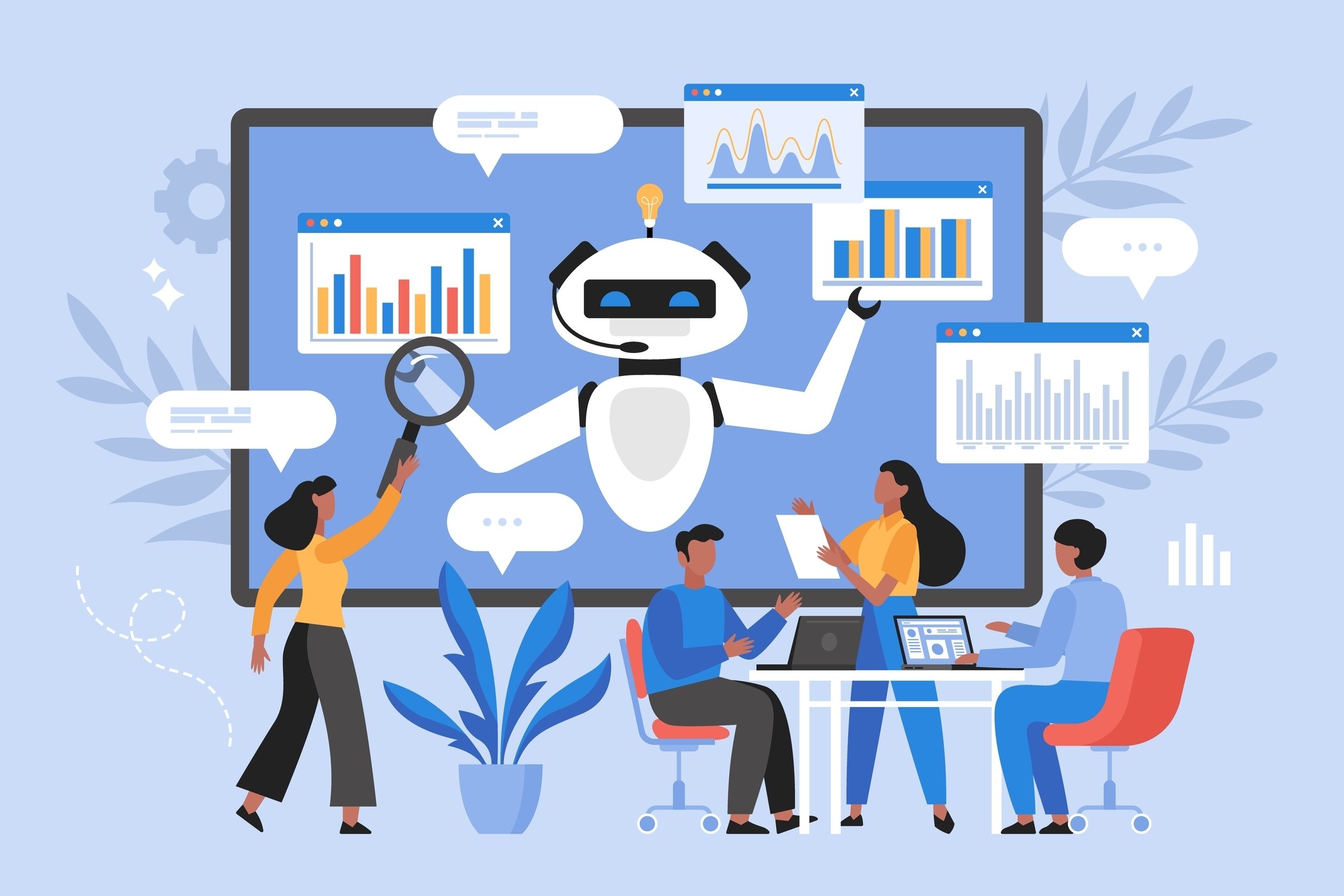
The strongest systems will combine machine-scale analysis with human understanding.
AI can identify patterns.
Humans provide meaning.
AI can generate variations.
Humans protect the brand.
AI can process signals.
Humans decide what those signals actually mean.
That combination is where an AI Marketing Agency Singapore strategy can create genuine value: not simply producing more personalised messages, but making personalisation more relevant, useful, and commercially meaningful.
The future of personalisation will not be about making every message different.
It will be about making every message more appropriate.
Human Oversight Will Become More Important, Not Less
There is a tempting fantasy surrounding AI marketing.
Build the workflow. Connect the tools. Turn everything on. Let the machines run.
Real marketing is rarely that simple.
AI can be remarkably capable, but capability does not equal judgement. A workflow can execute perfectly and still execute the wrong strategy.
It can generate thousands of words that nobody should publish. It can identify prospects that look valuable but have little real buying intent. It can personalise messaging using outdated assumptions. It can optimise a campaign toward a metric while quietly damaging the broader customer experience.
This is why human oversight will become more important as AI workflows become more sophisticated.
A mature AI Marketing Agency Singapore approach should treat AI as an intelligent layer within a larger marketing system, not as an unquestionable decision-maker.
Humans should remain responsible for areas where context, judgement, accountability, and brand understanding matter.
That includes strategy.
It includes positioning.
It includes creative direction.
It includes ethical decisions.
It includes approval of important customer-facing communications.
It also includes knowing when to ignore the machine.
This last skill may become surprisingly valuable.
If marketers become too dependent on AI recommendations, they risk creating a feedback loop where everyone follows similar patterns, uses similar language, and optimises for similar signals. Marketing then becomes efficient but forgettable.
Human creativity becomes the counterweight.
The goal should therefore be human-in-the-loop marketing.
AI handles volume.
Humans handle judgement.
AI identifies patterns.
Humans interpret them.
AI accelerates production.
Humans decide what deserves to exist.
This balance will separate serious AI adoption from superficial automation.
The smartest marketing teams will not ask how much human involvement they can eliminate.
They will ask where human involvement creates the most value.
That is a much harder question.
It is also the more important one.
Conclusion
The next generation of marketing teams may not look dramatically different on an organisational chart.
There will still be strategists. Writers. Designers. Demand-generation specialists. SEO professionals. Sales teams. Marketing leaders.
What changes is how these people work together.
Instead of relying primarily on manual handoffs, they will increasingly operate through interconnected AI workflows.
An AI Marketing Agency Singapore model reflects this broader transition: AI becomes part of the underlying marketing infrastructure rather than another application sitting on the side.
For businesses beginning this transition, the first step is not buying more AI tools.
It is mapping the work.
Where does marketing spend the most time?
Which processes are repetitive?
Where is information manually copied from one platform to another?
Where do leads become stuck?
Which decisions are based on incomplete information?
Which reports take hours to prepare but provide little insight?
Where could AI assist without compromising quality or accountability?
Once those questions are answered, businesses can begin designing workflows around actual business problems.
The process can be straightforward.
Identify the repetitive work.
Map the current process.
Determine where AI can assist.
Connect the relevant systems.
Define human approval points.
Measure the outcome.
Then improve the workflow.
This last step matters because AI marketing systems should never be treated as finished projects. Customer behaviour changes. Platforms change. AI capabilities change. Business priorities change.
The workflow must evolve with them.
An AI Marketing Agency Singapore can therefore be part of a larger strategic conversation about how businesses redesign their marketing operations for an AI-driven environment.
The biggest competitive advantage will not necessarily belong to the company using the newest AI model.
It will belong to the company that has figured out how to make people, data, technology, creativity, and decision-making work together.
The future of marketing is not simply automated.
It is orchestrated.
And the teams that learn to build those intelligent workflows today will be the teams defining how marketing operates tomorrow.
