

The Agentic Marketing Revolution: How AI Agents Will Change Marketing in 2027
September 2, 2026 at 5:06 pm
The AI Content Saturation Problem: How Brands Can Stand Out When Everyone Uses AI
September 3, 2026 at 6:04 pm
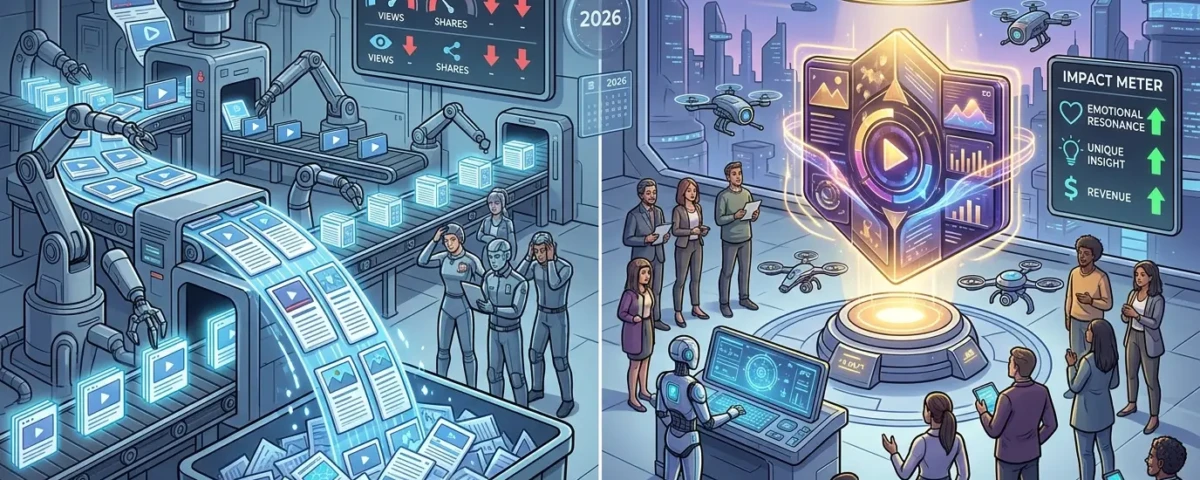
The content game has changed.
For years, marketers were told that consistency wins. Publish more blog posts. Create more social media content. Send more emails. Produce more videos. Build more landing pages. The logic was simple: the more content you put into the market, the more opportunities you create to attract attention.
Artificial intelligence has completely disrupted that equation.
Today, producing content is no longer the difficult part. AI can help businesses generate written content, images, videos, advertising creatives, and other marketing assets at a speed that would have been difficult to imagine only a few years ago.
That sounds like an enormous advantage. And it is—but only up to a point.
When everyone can produce more content, producing more content stops being a meaningful differentiator.
The real competitive advantage in 2026 is knowing what deserves to be created, why it matters, who it is meant for, and how it contributes to a larger business objective.
That is where AI Content Generation Singapore becomes more than a production tool. It becomes part of a smarter content strategy.
The winners will not necessarily be the companies publishing the most.
They will be the companies producing content that is harder to ignore.
We are entering an era where content supply is no longer scarce.
A marketing team that once needed several days to produce a campaign asset can now use AI to generate concepts, drafts, visuals, variations, and supporting materials in a fraction of the time. AI-powered content generation can support everything from articles and product descriptions to visual assets and videos.
That changes the economics of content marketing.
Previously, the bottleneck was production. Companies had limited creative resources, limited writers, limited designers, and limited hours in the day.
Now the bottleneck is increasingly judgment.
What should we create?
What should we ignore?
Which audience deserves our attention?
Which problem is worth solving?
Which idea is genuinely different?
These questions matter because the internet is becoming increasingly crowded with content that sounds remarkably similar.
The problem is not that AI creates bad content. The bigger problem is that AI makes average content incredibly easy to produce.
A company can publish five articles a week and still have nothing meaningful to say.
It can create dozens of LinkedIn posts and generate almost no engagement.
It can produce polished videos that attract views without producing a single qualified lead.
This is why AI Content Generation Singapore should not be viewed simply as a machine for producing more marketing assets.
Used properly, AI can help organizations move faster while human expertise determines the message, positioning, insight, and commercial purpose behind those assets.
In 2026, content volume is becoming table stakes.
Strategic relevance is becoming the differentiator.
AI Made Content Cheap — But Attention Remains Expensive
There is a brutal reality every marketer needs to accept: your audience does not care how easy your content was to create.
They care whether it is worth their time.
AI has dramatically reduced the cost of producing content. But it has not reduced the value of human attention.
If anything, attention has become more valuable.
Think about the average professional’s digital environment. Their inbox is full. Their LinkedIn feed is crowded. Their search results are overflowing. Their social feeds constantly deliver new videos, advertisements, opinions, newsletters, and recommendations.
Adding another generic article to that environment does not automatically create value.
This is where businesses need to rethink AI Content Generation Singapore.
The objective should not be to flood every channel with AI-generated material.
The objective should be to create material that earns attention.
That requires understanding the difference between visibility and relevance.
A generic “10 tips for better marketing” article may technically target a keyword, but it competes against thousands of similar articles.
A deeply researched analysis of a specific industry problem, supported by original observations and practical recommendations, has a much stronger reason to exist.
The same principle applies to video.
A company can generate an impressive AI video in minutes. But if the first five seconds do not address a genuine customer problem, the production quality becomes irrelevant.
The lesson is simple: AI can multiply output, but it cannot manufacture audience interest by itself.
The smarter approach is to use AI Content Generation Singapore to accelerate the production process while investing human thinking into the ideas that deserve amplification.
The future belongs to marketers who understand that attention must be earned, not generated.

The Real Advantage Is Strategic AI Content Creation
The next stage of AI content creation is not about replacing the content team.
It is about upgrading the way the entire content operation thinks.
Strategic AI content creation starts before the prompt is written.
It begins with audience intelligence.
What are customers searching for?
What objections are stopping them from buying?
What questions are sales teams hearing repeatedly?
What misconceptions exist within the market?
Where are competitors all saying the same thing?
Which subjects represent genuine opportunities for thought leadership?
These questions give AI something valuable to work with: direction.
Without strategy, AI becomes an extremely efficient content factory.
With strategy, it becomes an extremely powerful marketing engine.
A modern AI Content Generation Singapore workflow can support multiple stages of the process. AI can help researchers identify themes, marketers develop content angles, writers create initial drafts, designers develop visual concepts, and video teams transform ideas into short-form or long-form assets.
The technology can also help marketers personalize content for different audiences.
A single core idea might be adapted for a CEO, marketing director, sales leader, technical buyer, or procurement professional.
That is far more valuable than simply asking AI to “write another article.”
The distinction is critical.
Traditional content production asks:
“How much content can we create?”
Strategic AI content creation asks:
“What content will create the greatest impact?”
That shift changes everything.
It changes editorial calendars. It changes campaign planning. It changes how teams measure performance.
Most importantly, it changes the role of AI.
AI is no longer just the person in the room who writes faster.
It becomes part of an intelligent system designed to help marketers research, create, personalize, distribute, and optimize content at scale.
Generic AI Content Will Get Easier to Produce — And Harder to Trust
The irony of AI content is that its greatest strength can also become its greatest weakness.
AI can produce polished material extremely quickly.
But polished does not necessarily mean valuable.
As AI-generated content becomes more common, audiences will naturally become more sensitive to content that feels generic, repetitive, or manufactured.
The same introductions.
The same lists.
The same predictable recommendations.
The same corporate language.
The same recycled opinions.
This creates a new premium on originality.
Businesses need to inject something into their content that cannot simply be copied from the next website.
That could be proprietary data.
It could be original research.
It could be customer interviews.
It could be lessons from actual campaigns.
It could be expert commentary.
It could be a contrarian point of view.
It could simply be years of experience solving a specific problem.
This is where AI Content Generation Singapore should work alongside human expertise rather than attempting to replace it.
AI can structure an idea.
Humans can provide the experience behind it.
AI can generate multiple creative directions.
Humans can determine which direction actually fits the brand.
AI can transform a concept into a video or visual.
Humans can decide whether the concept is worth publishing in the first place.
That combination creates something much stronger than automated content.
It creates differentiated content.
In 2026, brands will increasingly compete on the depth of their knowledge, not simply the speed of their publishing.
The organizations that win will use AI to amplify what they know—not to hide the fact that they have nothing new to say.

Stop Creating More Content. Make Every Asset Work Harder.
There is another major shift happening in content marketing.
The best marketers are beginning to think less about individual pieces of content and more about content ecosystems.
One strong idea should not live in one blog post.
It should travel.
Imagine a company publishes an original research-based article about the future of B2B marketing.
That one asset could become a LinkedIn article.
Then several LinkedIn posts.
Then a short-form video series.
Then an email newsletter.
Then an infographic.
Then a sales presentation.
Then a downloadable guide.
Then talking points for a sales team.
Then a webinar.
Then advertising creative.
This is where AI Content Generation Singapore becomes particularly powerful.
AI can help transform one strong piece of intellectual property into multiple formats without forcing the marketing team to start from zero every time.
The goal is not content duplication.
It is intelligent repurposing.
Each format should be adapted to its audience and platform.
A LinkedIn post should not simply be a shortened blog article.
A video should not simply read the blog aloud.
An email should not simply copy the introduction.
The core insight remains consistent while the presentation changes.
This creates what can be called content leverage.
Instead of asking how many assets the marketing team can create in a month, ask how much value can be extracted from every strong idea.
That is a much smarter measurement.
A single excellent insight that becomes ten useful marketing assets can be more valuable than twenty disconnected pieces of mediocre content.
AI makes this possible at scale.
But the strategic thinking still comes first.
Content Needs to Stop Chasing Metrics and Start Driving Revenue
One of the biggest mistakes businesses can make in the AI era is confusing activity with performance.
Publishing 100 pieces of content sounds impressive.
But what happened afterward?
Did qualified traffic increase?
Did prospects spend more time researching the company?
Did more people request a consultation?
Did sales conversations improve?
Did the content influence pipeline?
Did conversion rates increase?
Those are harder questions—and they are far more important.
The next evolution of AI Content Generation Singapore is therefore closely connected to measurable business outcomes.
Content should not exist in isolation.
It should connect with the broader marketing and sales system.
A blog can attract search traffic.
That traffic can enter a landing page.
The visitor can consume a useful resource.
The prospect can become a lead.
Marketing automation can nurture that lead.
Sales can receive relevant intelligence.
The organization can then determine which content influenced the journey.
This creates a feedback loop.
AI can help marketers identify which subjects generate engagement, which formats perform best, which audiences respond to particular messages, and where content opportunities exist.
That makes content strategy increasingly data-driven.
But there is an important warning here.
Do not optimize everything for clicks.
Clicks are easy to chase.
Revenue is harder.
A sensational headline might generate traffic but attract the wrong audience.
A highly specific article might generate fewer visitors but produce several qualified sales conversations.
The second outcome is often far more valuable.
In 2026, sophisticated marketing teams will increasingly ask one question:
“What did this content actually accomplish?”
That question will separate content marketing from content theatre.
Conclusion
The future of content creation is not about slowing down.
It is about becoming more deliberate.
AI will continue making content production faster, cheaper, and more scalable. Businesses will have increasingly powerful tools for creating text, images, videos, advertising creatives, and other marketing assets.
That means the production advantage will continue shrinking.
Everyone will have access to the tools.
Not everyone will know how to use them strategically.
The companies that stand out will build content around a simple framework:
Research → Strategy → Create → Personalize → Distribute → Measure → Optimize.
Research identifies what matters.
Strategy determines what deserves attention.
AI accelerates creation.
Personalization makes the message relevant.
Distribution gets the content in front of the right people.
Measurement reveals what works.
Optimization makes the system stronger over time.
That is the real opportunity behind AI Content Generation Singapore.
The technology is not valuable simply because it can produce 50 pieces of content overnight.
It is valuable because it can help a business turn one strong idea into a coordinated campaign, adapt messaging for different audiences, create visual and video assets faster, and continuously improve its content operation.
The content arms race is changing.
The winners will not necessarily be the companies with the biggest publishing calendars.
They will be the companies with the clearest ideas.
The strongest customer understanding.
The most useful expertise.
The smartest distribution.
And the discipline to stop creating content simply because they can.
In 2026, more content is not the advantage.
Better content, smarter systems, deeper insight, and stronger commercial intent are.
AI gives businesses the ability to move faster.
The real competitive advantage is knowing where to go.
