

The Future of Sales Meetings: AI Before, During and After Every Client Call
August 31, 2026 at 8:25 pm
AI Content Creation in 2026: Why Producing More Content Is No Longer the Advantage
September 2, 2026 at 5:19 pm
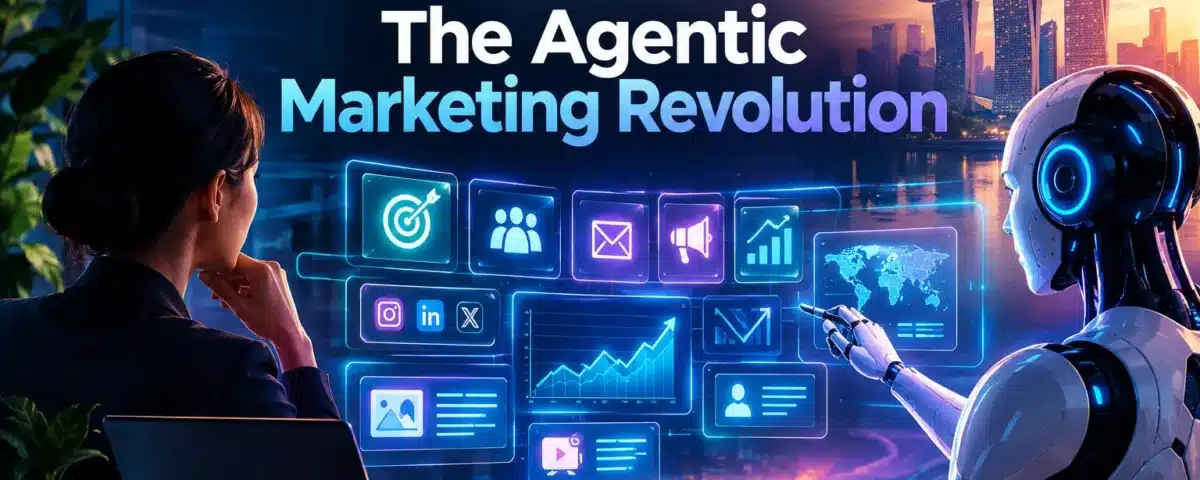
Marketing has always been about one thing: getting the right message in front of the right customer at the right moment.
But the way businesses accomplish that is changing fast.
For years, marketers have used automation to schedule emails, publish social posts, segment databases, trigger workflows, and report on campaign performance. Then generative AI arrived and changed the production layer. Suddenly, machines could write articles, create images, analyze data, generate advertisements, summarize customer conversations, and produce campaign variations in seconds.
Now the next shift is arriving.
AI is moving from generating outputs to taking action.
This is the foundation of agentic marketing.
Instead of asking an AI system to perform one isolated task, marketers can increasingly give AI agents a business objective and allow them to plan multiple steps, use connected tools, analyze results, and take additional actions. Salesforce, BCG, McKinsey, and other major industry observers are already documenting the movement toward agent-led marketing workflows. BCG’s 2026 CMO research found that nearly a third of surveyed marketers had already moved toward agent-led workflows, although only 8% reported campaigns where multiple agents operated autonomously.
That gap is important.
The agentic marketing revolution is not simply about replacing marketers with machines. It is about changing the operating system of marketing itself.
By 2027, the competitive question may no longer be whether a company uses AI. The real question will be: how intelligently can that company deploy AI agents to turn strategy into continuous execution?
Traditional marketing automation follows instructions.
Agentic marketing follows objectives.
That distinction sounds subtle, but it could completely change how marketing departments operate.
A traditional automation workflow might say: when someone downloads an ebook, send them an email three days later. If they open it, send another email. If they click, notify sales.
Useful? Absolutely.
Autonomous? Not really.
An AI agent can operate at a different level. Give it an objective such as increasing qualified demo requests from a specific customer segment, and the agent can potentially analyze existing data, identify opportunities, research competitors, create campaign variations, coordinate content, monitor engagement, and recommend or execute adjustments.
That is the fundamental difference between automation and agency.
The technology is already moving in this direction. Salesforce describes AI marketing agents as systems capable of reasoning through data and executing activities such as segmentation, personalization, and campaign activation. Braze similarly describes autonomous marketing as AI agents planning, executing, optimizing, and iterating campaigns with minimal human intervention.
For businesses working with an AI Marketing Agency Singapore, this shift creates a much larger opportunity than simply producing AI-generated content faster.
The objective becomes building an intelligent marketing engine.
Imagine a system that continuously watches campaign performance, studies customer behavior, identifies underperforming segments, recommends new messaging, creates variations, and alerts the marketing team when a strategic decision requires human judgment.
That is where marketing starts becoming less like a production line and more like a living system.
By 2027, companies that understand this distinction could have a serious operational advantage.
The winners will not necessarily be the businesses with the most AI tools.
They will be the businesses that connect those tools into a coherent system capable of learning and acting.

AI Marketing Agents Will Become the New Digital Workforce
The phrase “AI agent” can sound futuristic, but the basic concept is becoming increasingly practical.
An AI marketing agent is essentially a specialized digital worker designed around a specific objective, a defined knowledge base, a set of actions, and operational boundaries.
Think about a modern marketing department.
There is someone responsible for SEO.
Someone handles content.
Someone analyzes customer data.
Someone manages paid advertising.
Someone works on email campaigns.
Someone monitors social media.
Someone researches competitors.
Someone qualifies leads.
In an agentic marketing environment, many of these responsibilities could be supported by specialized AI agents.
One agent might continuously monitor search opportunities.
Another might analyze customer conversations.
Another could research competitors.
Another could generate campaign assets from an approved brand strategy.
Another could monitor paid-media performance.
Another could identify promising B2B accounts.
Another could analyze conversion data and recommend changes.
This does not necessarily mean a company will fire its marketing department and replace everyone with software. In fact, current evidence suggests that the more realistic model is human marketers managing increasingly capable AI systems. Salesforce’s current agentic marketing approach, for example, positions agents as collaborators that help marketers build pipeline, create content, and run campaigns while humans retain strategic ownership.
For an AI Marketing Agency Singapore, this creates an entirely different service model.
Instead of selling isolated marketing tasks, agencies can increasingly build connected AI-powered systems around business objectives.
The marketer becomes the strategist.
The AI agent becomes the execution engine.
The human defines the destination.
The machine handles more of the road.
That relationship will require careful governance. AI agents need clear permissions, reliable data, brand guidelines, security controls, and escalation rules. Salesforce’s framework specifically highlights role, knowledge, actions, guardrails, and channels as foundational elements of an effective marketing agent.
The future marketing team may therefore look less like a collection of people performing repetitive tasks and more like a command center coordinating humans and intelligent digital workers.

Campaigns Will Stop Being Projects and Become Continuous Growth Engines
Traditional campaigns have a beginning, middle, and end.
A team researches the audience.
The creative team produces assets.
The media team launches advertisements.
The marketing team watches the numbers.
After several weeks, everyone gathers around a report and decides what happened.
Agentic marketing can compress that entire cycle.
Instead of waiting for a campaign review at the end of the month, AI systems can continuously monitor performance and react to changing signals.
A campaign might begin with one hypothesis.
The agent observes that one customer segment is converting better than expected.
It identifies the strongest messaging.
It detects that another segment is generating clicks but not qualified leads.
It recommends changing the offer.
It generates alternative messaging.
It runs approved experiments.
It measures the results.
Then it feeds those insights into the next decision.
This creates a continuous feedback loop.
Research from McKinsey describes the future of marketing as a shift away from isolated campaigns toward a continuous growth engine integrating insights, content, commerce, personalization, and performance.
This is where an AI Marketing Agency Singapore can become more than a content or advertising provider.
The agency can help design the architecture behind continuous optimization.
That could involve connecting CRM data, website behavior, advertising performance, SEO data, content performance, and customer interactions.
The objective is not simply to automate more tasks.
It is to create a marketing system that learns faster.
That distinction matters because speed is becoming a competitive weapon.
A company that discovers a new customer insight today and acts on it next month is operating under an entirely different model from a company that can identify the signal today, test a response tomorrow, and continuously optimize afterward.
By 2027, the best marketing teams may no longer ask, “How did our campaign perform?”
They may ask, “What did the system learn, what changed, and what should we do next?”
That is a far more powerful question.
B2B Lead Generation Will Shift From Volume to Timing and Intent
B2B marketing has always struggled with the same problem: there are too many potential prospects and too little attention.
Sales teams cannot investigate every company.
Marketing teams cannot personalize every message manually.
And buying journeys are rarely linear.
This is where AI agents could make a major impact.
Instead of simply generating another list of thousands of companies, AI agents can potentially monitor accounts continuously for relevant signals.
A company hires a new executive.
It enters a new market.
It launches a new product.
Its website changes.
Its technology stack changes.
It publishes content around a specific business problem.
Its executives become active on professional networks.
A competitor loses a major account.
Any of these signals could potentially indicate a change in buying intent.
An AI-driven system can monitor large volumes of information far more consistently than a human team.
This creates an opportunity to move B2B lead generation away from static databases and toward dynamic intelligence.
For an AI Marketing Agency Singapore, this means B2B campaigns can become increasingly focused on identifying who matters now rather than simply who matches a demographic profile.
The difference is enormous.
An ideal customer profile tells you who could buy.
Intent signals can help indicate who may be ready to consider buying.
AI agents could combine firmographic data, behavioral signals, website activity, CRM information, content engagement, and external business intelligence to prioritize accounts.
The next step is personalization.
Rather than sending the same generic message to hundreds of prospects, agents could help create account-specific outreach based on the prospect’s business context.
But there is a hard truth here.
More automation does not automatically create better lead generation.
Poor data produces poor decisions.
Bad targeting produces irrelevant outreach.
Weak positioning produces automated noise.
The agent is only as good as the strategy, information, and constraints surrounding it.
That is why businesses need to treat agentic lead generation as a strategic system rather than another software subscription.
The future will not belong to companies that contact the most prospects.
It will belong to companies that understand which prospects matter, why they matter, and when to engage them.
Hyper-Personalization Will Finally Become a Reality—But It Comes With a Price
Marketing has promised personalization for years.
Yet much of what companies call personalization is still basic.
“Hi John.”
Recommended products.
Segment-specific emails.
A few dynamic website elements.
Useful, but hardly revolutionary.
AI agents could take personalization much further.
Imagine a customer visiting a website.
The system understands their previous interactions, industry, interests, buying stage, and engagement history.
Instead of simply showing a generic landing page, an AI-driven marketing system could dynamically adjust the experience based on what it knows about that individual or account.
The email could change.
The offer could change.
The recommended content could change.
The follow-up timing could change.
The sales notification could change.
And the system could learn from the response.
This is the direction in which agentic marketing is heading. Gartner predicts that by 2028, 60% of brands will use agentic AI for streamlined one-to-one interactions, reflecting a broader move away from traditional channel-based marketing toward autonomous customer journeys.
For an AI Marketing Agency Singapore, the challenge will be balancing personalization with trust.
Because there is a line between relevant and creepy.
A customer wants a company to understand their needs.
They do not necessarily want to feel watched.
That means businesses will need strong data governance, transparent practices, consent management, and clear boundaries around what AI can infer and act upon.
Privacy will become a competitive issue, not merely a compliance issue.
The brands that use AI to make customers feel understood will gain an advantage.
The brands that use AI to make customers feel manipulated will damage trust.
There is another important shift.
Personalization will increasingly need to work for machines as well as humans. Kantar has highlighted the emergence of AI agents acting on consumers’ behalf, suggesting that brands will increasingly need to make their products, information, and experiences understandable and discoverable by non-human decision-makers.
In other words, the future customer journey may involve both a human and an AI agent evaluating your brand.
Marketing has just acquired a new audience.
The CMO’s Job Will Change From Managing Campaigns to Orchestrating Intelligence
The marketing department of 2027 may look strangely different.
There may be fewer hours spent pulling reports.
Fewer manual spreadsheet updates.
Fewer repetitive campaign adjustments.
Fewer meetings where people simply explain what happened last week.
Instead, marketers may spend more time defining objectives, reviewing AI recommendations, managing systems, protecting brand standards, interpreting customer behavior, and making high-level strategic decisions.
That is a significant change in the role of the marketer.
The CMO becomes less of a campaign manager and more of an orchestrator.
This matters because AI agents cannot replace strategic context simply by becoming faster.
They can analyze.
They can generate.
They can execute.
They can optimize within defined parameters.
But someone still needs to decide what the company should stand for.
Someone needs to determine which customers matter most.
Someone needs to understand the political, cultural, and emotional context behind a market.
Someone needs to protect the brand when an automated system makes the wrong call.
And someone needs to decide when not to automate.
This is where an AI Marketing Agency Singapore can play a strategic role in helping organizations transition from traditional workflows to AI-enabled operating models.
The challenge is not simply teaching employees how to use ChatGPT or another AI platform.
The deeper challenge is redesigning the workflow.
What decisions should AI make?
What decisions require approval?
Which systems need to be connected?
What data can agents access?
What actions can they take?
What happens when an agent gets something wrong?
These questions become increasingly important as autonomy increases.
The recent experience of major technology companies also provides a warning against blindly assuming that more AI autonomy automatically means more productivity. Reuters reported that Meta’s 2026 effort to reorganize parts of its workforce around AI encountered significant implementation and productivity challenges, prompting a more cautious approach.
The lesson is simple.
Do not automate chaos.
First build the strategy.
Then build the system.
Then let the agents execute within clear boundaries.
Conclusion
The marketing industry is heading toward an important crossroads.
One path is familiar.
Companies continue buying more AI tools.
One tool writes content.
Another creates images.
Another analyzes keywords.
Another manages social media.
Another generates leads.
Another produces reports.
The result?
More software.
More subscriptions.
More dashboards.
And potentially more fragmentation.
The other path is agentic.
Instead of collecting disconnected tools, companies build intelligent systems around clear business objectives.
The system understands the customer.
It understands the brand.
It understands the available data.
It has access to approved tools.
It knows its boundaries.
It can execute defined tasks.
It can measure outcomes.
And it can escalate important decisions to humans.
That is the real promise of the agentic marketing revolution.
An AI Marketing Agency Singapore can help businesses think beyond individual AI applications and toward an integrated marketing architecture where strategy, data, content, lead generation, SEO, automation, and customer engagement work together.
But businesses should not rush into autonomy simply because the technology is impressive.
Agentic AI introduces real risks. Autonomous systems can make incorrect decisions, expose sensitive information, create brand problems, or execute actions at scale before a human notices. Recent reporting on AI agents has already highlighted emerging questions around accountability, security, and insurance.
The smart approach is controlled autonomy.
Start with repetitive, measurable workflows.
Give agents limited permissions.
Establish clear guardrails.
Measure outcomes.
Keep humans involved in consequential decisions.
Then expand autonomy as confidence grows.
By 2027, the defining competitive advantage may not be access to artificial intelligence. Everyone will have access to increasingly capable AI.
The advantage will come from knowing how to orchestrate it.
The future marketer will not simply ask AI to write faster.
They will build systems that think, act, learn, and improve.
The future marketing agency will not simply deliver campaigns.
It will help businesses build intelligent growth engines.
And the future customer will not always interact with a company directly.
Sometimes, an AI agent will make the first decision.
That changes the game completely.
The agentic marketing revolution is therefore not about machines taking over marketing.
It is about marketing becoming more intelligent, continuous, adaptive, and autonomous.
The companies that prepare now will have time to build the data foundations, governance, strategy, and human expertise required to make that transition work.
The companies that wait may find themselves competing against businesses whose marketing systems never sleep, never stop learning, and can act on opportunities in real time.
In 2027, the question will not be whether AI changed marketing.
It will be whether your marketing organization changed with it.
