

The Biggest Mistake B2B Companies Make When Using ChatGPT for Lead Generation
July 23, 2026 at 9:22 pm
AI Lead Generation vs Traditional Digital Marketing: Which Delivers Better ROI?
July 24, 2026 at 2:42 pm
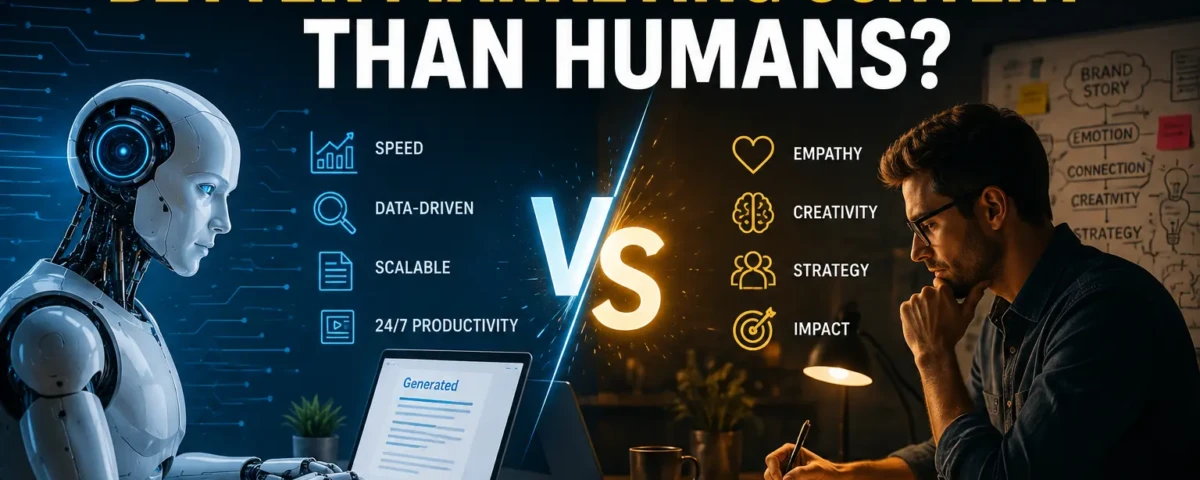
Artificial intelligence has transformed nearly every corner of digital marketing. What once required teams of copywriters, editors, SEO specialists, and strategists can now be accomplished in minutes with the right AI platform. Blog posts, email campaigns, product descriptions, social media captions, video scripts, and even advertising copy can all be generated almost instantly. It’s no surprise that businesses around the world are asking the same question: Can AI really write better marketing content than humans?
The answer isn’t as straightforward as many believe.
AI has undoubtedly changed the speed and economics of content creation. Companies that once struggled to maintain a consistent publishing schedule can now produce articles, newsletters, and promotional materials at scale. For businesses competing in crowded markets, especially those focused on digital growth, this represents an enormous competitive advantage.
Yet marketing has never been solely about producing words. Great marketing persuades. It builds trust. It creates emotional connections. It turns curious prospects into loyal customers. These outcomes require more than algorithms—they require understanding people.
This is where the debate becomes fascinating. AI excels at processing vast amounts of information, identifying patterns, and generating structured content. Humans excel at storytelling, empathy, strategic thinking, and creating memorable brand experiences. Rather than asking whether AI is replacing marketers, perhaps the better question is how businesses can combine both strengths to achieve exceptional results.
Organizations investing in AI Content Generation Singapore are already discovering that success comes from treating AI as a strategic partner rather than a complete replacement. The companies seeing the greatest return are those that leverage automation to increase productivity while allowing experienced marketers to shape messaging, refine narratives, and ensure every piece of content aligns with their brand voice.
The future of marketing doesn’t belong exclusively to humans or machines. It belongs to businesses that understand how both can work together to create faster, smarter, and more impactful content.

Where AI Falls Short: The Hidden Weaknesses Every Marketer Must Understand
Artificial intelligence is an extraordinary tool, but it is not infallible. As businesses rush to embrace AI-powered writing, many discover an uncomfortable truth: speed does not always equal quality. While AI can generate content at remarkable scale, it still lacks the judgment, intuition, and contextual understanding that experienced marketers bring to the table.
One of AI’s biggest weaknesses is its tendency to produce content that sounds authoritative even when it contains inaccuracies. Because AI predicts language rather than verifies facts, it can confidently present outdated information, misinterpret statistics, or fabricate supporting details. For industries such as finance, healthcare, legal services, or B2B technology, these mistakes can damage credibility and erode customer trust.
Another challenge is originality. AI learns from patterns found across vast amounts of existing content. Without detailed prompts and careful editing, the result often feels generic. Readers have become increasingly adept at recognizing repetitive phrasing, predictable structures, and surface-level insights. Publishing this type of content may fill a website with words, but it rarely establishes thought leadership or differentiates a brand from its competitors.
Brand voice is another area where AI struggles. Every successful business has a unique personality that reflects its values, culture, and customer relationships. A luxury brand communicates differently from a technology startup, and a family-owned business speaks differently from a multinational corporation. AI can imitate these styles, but it cannot instinctively understand the subtle nuances that make a brand authentic. This is why companies using AI Content Generation Singapore should always include human editors who understand their organization’s identity.
Creativity also suffers when AI is left to work alone. Groundbreaking campaigns often emerge from unexpected ideas, emotional experiences, and unconventional thinking. AI excels at recognizing patterns from the past, but truly memorable marketing often breaks those patterns. It challenges assumptions, sparks conversations, and introduces fresh perspectives that resonate with audiences on a deeper level.
Ethical considerations further highlight the need for human oversight. Businesses must ensure that AI-generated content respects copyright, avoids bias, maintains transparency, and aligns with regulatory requirements. Simply because AI can generate content does not mean every piece should be published without review.
The smartest marketers understand that AI Content Generation Singapore is most effective when paired with critical thinking. AI should accelerate workflows, not replace editorial judgment. Human expertise remains essential for fact-checking, refining messaging, injecting personality, and ensuring every article strengthens the brand’s reputation rather than weakening it.
The Winning Formula: Why AI and Human Expertise Create Marketing That Actually Converts
The future of content marketing is not a battle between artificial intelligence and human writers. It is a partnership. Businesses that frame AI as a replacement for marketers often end up with content that is technically correct but emotionally forgettable. Those that combine AI’s efficiency with human creativity consistently produce stronger campaigns, higher engagement, and better business outcomes.
Think of AI as an exceptionally capable assistant rather than an autonomous marketing strategist. It can analyze search trends, organize information, generate outlines, draft articles, suggest headlines, and optimize content for SEO in a fraction of the time required by traditional methods. These capabilities dramatically reduce production time and free marketers to focus on what truly matters—strategy, storytelling, customer psychology, and brand positioning.
An effective workflow begins with AI handling research, competitive analysis, keyword clustering, and first drafts. Marketing professionals then step in to validate facts, strengthen arguments, refine tone, and ensure the content reflects the company’s expertise and unique value proposition. This collaborative approach transforms average content into compelling marketing assets that educate, persuade, and convert.
Organizations embracing AI Content Generation Singapore are increasingly adopting this hybrid model because it delivers the best of both worlds. AI accelerates execution while experienced marketers provide insight, originality, and emotional intelligence that machines cannot replicate. The result is content that is faster to produce without sacrificing authenticity or quality.
This partnership also enables greater personalization. AI can analyze customer behavior and segment audiences based on interests, demographics, or purchasing intent. Human marketers then tailor messaging to address the motivations, concerns, and aspirations of each audience segment. Together, they create experiences that feel relevant rather than automated.
Perhaps the greatest advantage of this approach is continuous improvement. AI learns from performance data, while marketers interpret those insights within the broader context of business goals and market conditions. Every campaign becomes an opportunity to refine messaging, improve customer engagement, and increase return on investment.
Businesses that succeed over the next decade will not be those that rely entirely on AI or reject it altogether. They will be the organizations that understand how to integrate technology with human expertise. By leveraging AI Content Generation Singapore alongside experienced content strategists, brands can produce marketing that is not only faster and more scalable but also more persuasive, trustworthy, and impactful.
The Future of Marketing Belongs to Businesses That Master AI, Not Fear It
The conversation has evolved beyond whether businesses should adopt artificial intelligence. The real question is how quickly they can integrate it into their marketing strategy without compromising quality, authenticity, or customer trust. AI is no longer an emerging trend—it has become a competitive advantage for organizations that know how to use it strategically.
Over the next few years, AI will become deeply embedded in every stage of the marketing journey. Instead of creating one generic campaign for everyone, businesses will produce personalized experiences for different audiences based on customer behavior, purchase history, search intent, and engagement patterns. Content will become increasingly relevant because AI can process vast amounts of data and identify opportunities that would take humans days or even weeks to uncover.
Search engine optimization is also entering a new era. Success is no longer determined simply by publishing the highest volume of content. Search engines are becoming better at identifying helpful, trustworthy, and experience-driven content that genuinely answers users’ questions. This means businesses must prioritize quality over quantity. AI can accelerate content production, but it cannot replace the expertise, authority, and credibility that human professionals contribute.
Companies investing in AI Content Generation Singapore are already discovering that AI extends far beyond blog writing. Today’s tools can generate videos, podcasts, infographics, email campaigns, social media content, sales presentations, and even personalized customer communications. As AI continues to evolve, businesses will have even greater opportunities to create seamless, multi-channel marketing campaigns that deliver consistent messaging across every customer touchpoint.
However, technology alone will never guarantee success. Businesses that simply automate content without a clear strategy risk flooding the internet with generic information that fails to build trust or differentiate their brand. The organizations that thrive will be those that combine AI efficiency with human insight, creativity, and strategic thinking.
Investing in AI Content Generation Singapore is therefore not just about adopting new software. It is about rethinking how marketing teams operate, empowering employees with better tools, and creating a workflow where technology enhances human expertise rather than replacing it. Companies that embrace this mindset today will be better positioned to adapt to tomorrow’s rapidly changing digital landscape.
Conclusion
So, can AI really write better marketing content than humans?
The answer is both yes and no.
If the goal is to produce content quickly, generate multiple variations, automate repetitive writing tasks, and scale production across dozens of marketing channels, AI clearly has the advantage. It works around the clock, processes enormous amounts of information, and dramatically reduces the time required to create first drafts. These capabilities make AI an invaluable asset for modern marketing teams.
But if the objective is to inspire trust, build emotional connections, tell compelling stories, establish thought leadership, and influence complex purchasing decisions, human expertise remains irreplaceable. Marketing has always been about understanding people—their motivations, fears, ambitions, and aspirations. Those qualities cannot be fully replicated by algorithms.
The businesses achieving the greatest success are not choosing one over the other. They are building integrated workflows where AI handles speed, automation, and data-driven optimization, while experienced marketers contribute creativity, strategic direction, critical thinking, and authentic storytelling. This combination produces content that is not only efficient but also meaningful, persuasive, and memorable.
Organizations embracing AI Content Generation Singapore are already proving that the future belongs to businesses willing to innovate responsibly. By leveraging AI to eliminate repetitive tasks and empowering skilled professionals to focus on high-value strategy, companies can create marketing campaigns that outperform traditional approaches in both efficiency and effectiveness.
Ultimately, AI is not the end of human creativity—it is a catalyst for it. The marketers who will lead the next generation of digital transformation are those who understand that technology is most powerful when guided by experience, wisdom, and purpose.
Rather than asking whether AI will replace human marketers, forward-thinking businesses should ask a more important question: How can we combine artificial intelligence with human expertise to create marketing that truly makes an impact?
The answer to that question will define the brands that lead tomorrow’s marketplace. Those who embrace AI Content Generation Singapore as part of a balanced, human-led strategy will not simply keep pace with change—they will help shape the future of marketing itself.
